
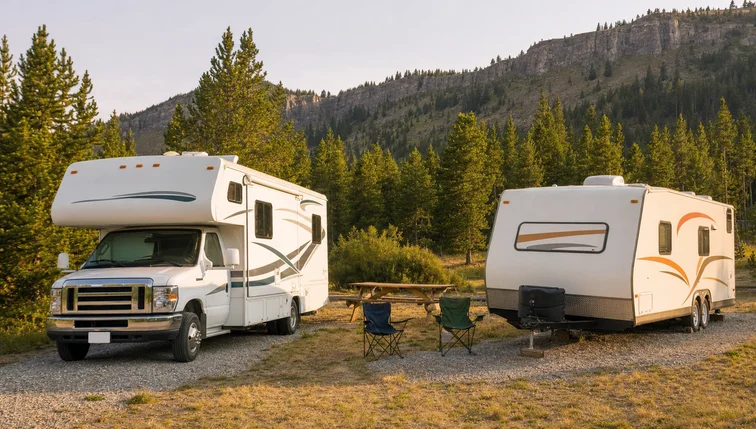
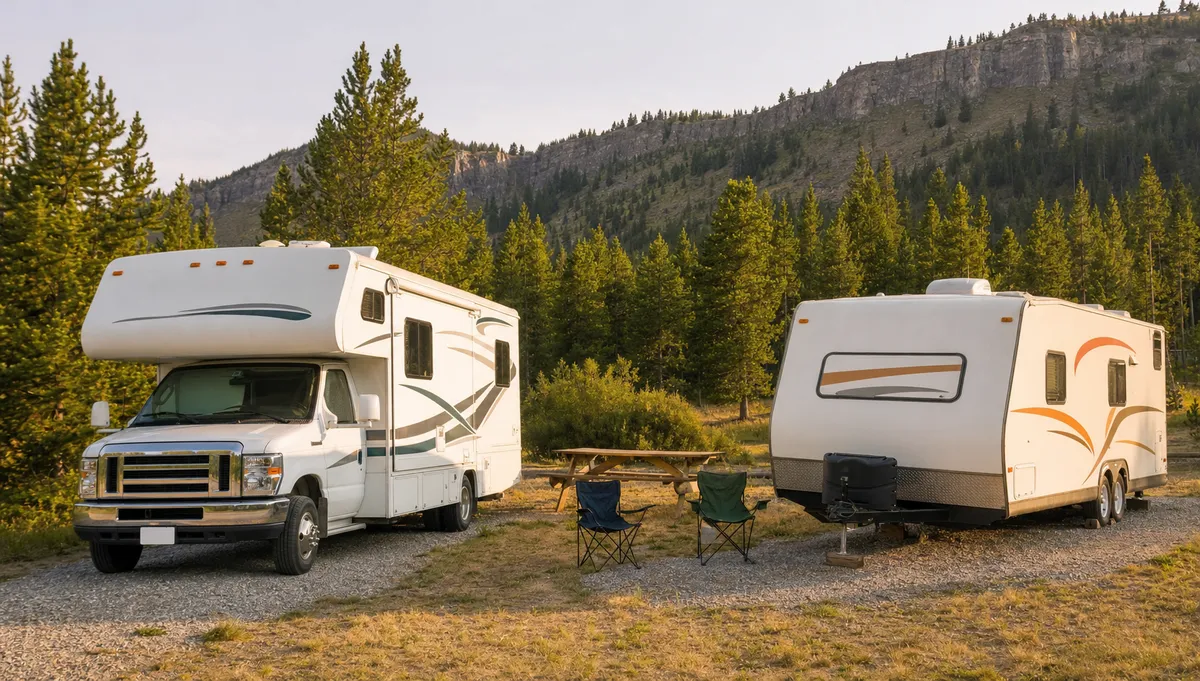
RV vs camper comes down to one question: does it have an engine? An RV is the umbrella term for any vehicle or trailer with living quarters, while a camper usually means a towable trailer or a truck camper. This guide sorts out the words, then compares the two on driving, cost, and comfort so you can choose with confidence.
What Each Word Means
People use these words loosely, which is why shopping feels confusing. Cruise America calls RV an umbrella term for any vehicle or trailer built with living quarters, from a small towable to a full-size motorhome.
The same page describes a camper as a smaller unit, such as a truck bed camper or a towable camping trailer, and notes that many people use the word for any RV in casual talk. That is why the word alone never tells you whether an engine is involved.
Truck campers are the one type with an official definition. California’s DMV handbook describes a truck camper as a detachable section designed to be transported on a pickup truck. Use this word map when you read a listing or talk to a seller.
| What people say | What it usually means | Drive or tow |
|---|---|---|
| RV | Anything with living quarters | Either |
| Motorhome | Class A, B, or C on one chassis | Drive |
| Camper | A small trailer or truck camper | Tow or carry |
| Travel trailer | A towable, often called a camper | Tow |
| Truck camper | A unit that sits in a pickup bed | Carry |
| Camper van | A van with a bed and kitchen | Drive |
When a seller says camper, ask one question: does it have its own engine? That single answer tells you whether you need a tow vehicle.
The Main Difference
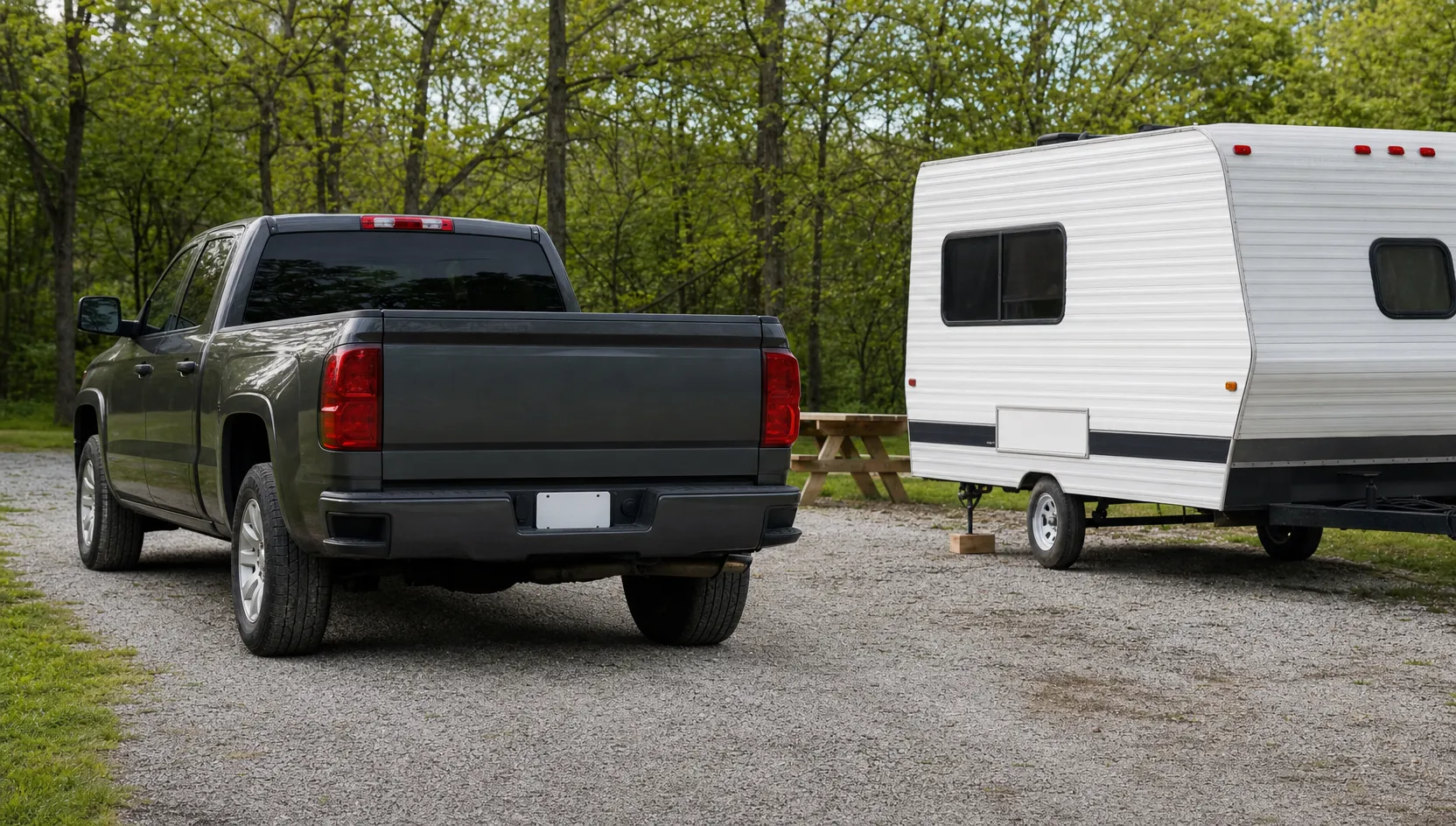
A motorhome drives itself, and a towable does not. Everything else flows from that: how you set up camp, what you spend, and what happens when something breaks. In everyday talk, “RV vs camper” comes down to motorhome vs towable.
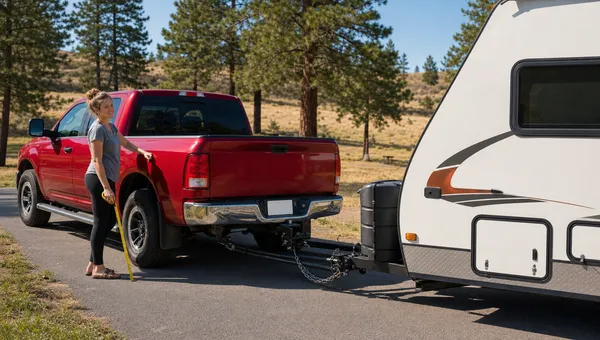
A towable needs a vehicle that can pull it, and Cruise America says towables also call for towing experience and comfort backing up. A motorized RV drives like a large van or bus.
A special license is rarely required in the U.S., though it varies by state and size. Our types of RVs guide covers every class and trailer style, so this guide focuses on the choice itself and what it means for you.
Driving and Setup
Setup is where the two feel most different. Camping World says towables set up more slowly because of hitching, leveling, and stabilizing, while a motorhome is ready sooner unless you also tow a car behind it to use at camp.
Day trips work in opposite ways. With a towable, you unhitch and take your truck or SUV into town. With a motorhome, you pack up camp or tow a small car behind it. Neither choice skips the learning curve: hitching, sway, and backing up take practice, and a large motorhome takes practice to handle too. Our first drive tips help with both.
Space and Comfort
Comfort depends on the size you choose more than the label. Cruise America lists sleeping capacity for motorhomes: up to 8 in a Class A, up to 6 in a Class C, and 2 to 4 in a Class B or camper van. Towables span an even wider range, and Bish’s RV lists travel trailers from 10 to 40 feet and fifth wheels from 20 to 45 feet.
Storage follows size as well. Cruise America says Class A motorhomes offer the most space of the motorized types and Class B the least, while larger motorhomes and fifth wheels generally give you the most storage overall. Bish’s RV adds that towables usually give you more living and sleeping space for the price.
Plan for storage when you are not on the road, too. Bish’s RV says motorhomes cost more to store, and a stored motorhome’s engine should run at least every two weeks, with fuel stabilizer for gas models. A trailer has no engine to exercise.
Cost Compared
Towables cost less up front, but the price you see leaves out the tow vehicle. Camping World lists these typical new prices (October 2026): entry-level travel trailers at $10,000 to $30,000, entry fifth wheels at $30,000 to $60,000, gas Class C motorhomes at $60,000 to $200,000, and gas Class A motorhomes at $80,000 to $350,000 or more.
Upkeep follows the same split. Bish’s RV says a towable needs only RV maintenance, while a motorhome needs both vehicle and RV maintenance.
Fuel is closer than most people expect, because Camping World notes that a diesel truck pulling a large fifth wheel gets only slightly better mileage than a diesel motorhome. See our gas mileage numbers before you budget for either one.
A breakdown hits differently too. If a trailer fails, your tow vehicle can still take you to a hotel or a shop. If a motorhome fails, you can lose your transportation and your home at once, which is worth weighing if you travel far from help.

Subscribe to
Our Newsletter
By joining, you agree to receive emails.
See our Privacy Policy.
Quick Pros and Cons

Here is where each side wins in everyday use, based on the Camping World and Bish’s RV comparisons. The right pick depends on how you plan to camp, not on which type sounds better.
- Towable: a lower price and often more living and sleeping space for the money.
- Towable: leave camp set up and drive your tow vehicle around.
- Towable: the tow vehicle still works if the trailer needs repairs.
- Motorhome: park and go, with no hitching or unhitching.
- Motorhome: easier to move between sites on a long trip.
- Motorhome: a higher price and more maintenance, plus storage costs.
Which One Fits You
You already own a tow vehicle. A towable is the natural fit, but check your vehicle’s limit first with our Towing Capacity Calculator. If you have no tow vehicle and don’t want to buy one, lean toward a motorhome.
You are nervous about towing. A motorhome removes hitching, sway, and backing up with a trailer. If you are willing to learn, a towable is a good value, and a short practice session in an empty lot makes a big difference.
You stay in one place for days. Towables shine here, because you set up once and use your tow vehicle for errands. If you move camp every day or two, the faster setup of a motorhome saves hours.
You explore from camp. A towable lets you leave the campsite standing while you drive off. A motorhome fits trips where you rarely leave the rig, or where you plan to tow a car behind it.
Try Before You Buy
Renting the type you like for a weekend tells you more than any article. You find out how it drives, how long setup takes, and whether everyone fits. Once you have a favorite, our ownership costs guide shows what it costs to keep it each year.
Your Next Step
Decide whether you want to drive your home or tow it, and the rest of the choice gets easier. Then rent one of each type for a weekend and let the trip tell you which one you enjoy more, before you spend a dollar on either.