
A weight distribution hitch uses spring bars to move part of a trailer’s tongue weight off the rear axle of your tow vehicle and onto the front axle and the trailer axles. That restores steering and braking when a trailer is heavy for its tow vehicle. The setup looks like a pile of steel and a rulebook, but it comes down to three choices: do you need one, which type fits, and how to set it up.
What the Hitch Does
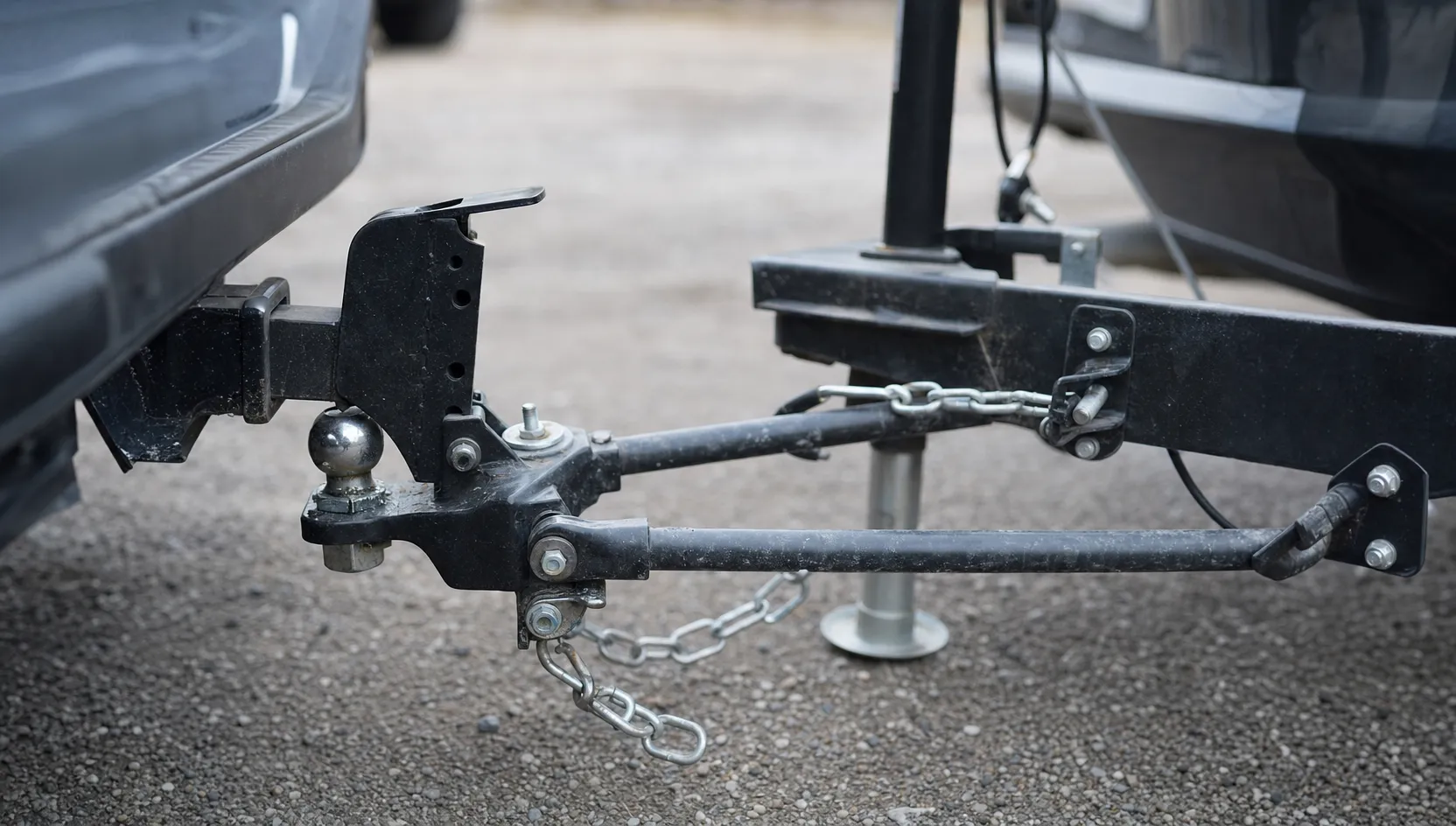
Every trailer presses down on your hitch ball, and that load is called tongue weight. Without help, it pushes the back of your tow vehicle down and lifts the front, which takes weight off the steering tires. The spring bars act as levers that shift part of that load forward again, as Camping World explains.
PickupTrucks shows the effect with a 1,000-pound tongue weight. With no hitch, the front axle loses 400 pounds and the rear axle gains 1,400. A setup that restores half the front weight cuts those numbers to 200 and 1,075, and puts 125 pounds on the trailer axles. The total never changes, so the hitch moves the load instead of removing it.
What It Won’t Do
A weight distribution hitch does not raise your towing capacity. Your vehicle’s tow rating, hitch rating, axle ratings, and tires each set a limit, and the lowest one wins. The hitch adds no capacity to any of them.
It does not shrink tongue weight either, because it only spreads that weight around, and it does not replace trailer brakes or careful loading. Check your vehicle’s tow rating with the Towing Capacity Calculator before you buy anything.
When You Need One
Your owner’s manual and truck maker’s towing guide come first, because they set the rule for your exact vehicle. With no rule, Camping World suggests a weight distribution hitch when the loaded trailer weighs more than half of your tow vehicle’s weight. A three-quarter-ton truck pulling a small pop-up may not need one, but a minivan might.
Half-ton trucks often name a hitch for trailers over 5,000 pounds or a tongue weight over 500 pounds, even though their tow ratings run much higher, PickupTrucks reports. Use the loaded trailer weight in your math, not the dry weight, because water, gear, and propane add up quickly. A full 40-gallon tank holds over 330 pounds of water alone.
Signs You Need One
Your truck often tells you before the scale does. Hitch up the loaded trailer without the spring bars, then look for these signs.
- The rear bumper drops several inches below its unhitched height.
- The front fenders rise, and the nose of the truck looks lifted.
- The steering feels light or vague on the highway.
- The headlights point above the road.
- The trailer sways or bounces more than you expect.
- Your manual names a hitch for your trailer weight.
Check Your Ratings
Size the hitch by loaded tongue weight, not by trailer weight. Tongue weight should run about 10 to 15 percent of the loaded trailer weight, and the hitch’s tongue-weight rating should cover it, etrailer says. Camping World adds that listed hitch weights assume an empty trailer, so a measured number beats a brochure.
Run your numbers in the Tongue Weight Calculator, then compare the result with your truck’s limits in the Payload Calculator. The hitch hardware adds weight too, about 100 pounds according to etrailer, and all of it counts against your payload.
Read Your Receiver Label
The receiver under your bumper has its own class and ratings. Camping World lists Class III at up to 5,000 pounds, Class IV at up to 10,000, and Class V at up to 20,000. Most receivers carry two sets of numbers, one for weight carrying and one for weight distribution.
The second set is usually higher by a few hundred pounds. One Class III receiver on etrailer lists 6,000 pounds and 600 pounds of tongue weight without a distribution system, and 7,500 and 750 with one. Your vehicle’s own tow rating still applies.
Pick a Hitch Type
Hitches differ in how they hold the spring bars and how they handle sway. First confirm that yours fits your vehicle: Camping World says almost any truck can use one, but vans and SUVs need research because of their unibody construction. Surge-brake trailers, common on boats, also need a compatible hitch, according to PickupTrucks.
Round Bar or Trunnion
Round bar hitches cost less and sit lower, so they suit trucks, while trunnion bars cost more, clear the ground better, and fit nearly any vehicle, including vans and SUVs. Chain systems adjust with links and snap-up brackets. L-bracket systems adjust with the tongue jack and add a sway-control point, Camping World notes.
Sway Control Options
Weight distribution and sway control are different jobs, and many hitches combine them. A sway bar alone does not move any weight to the front axle. Friction types add drag at the connection to calm sway while still letting you turn, and bracket-style hitches hold the bars against the trailer frame instead of using chains.
Measure Before You Couple
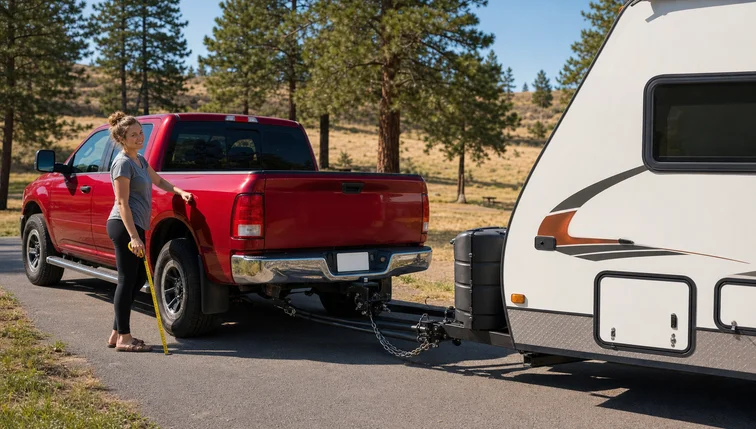
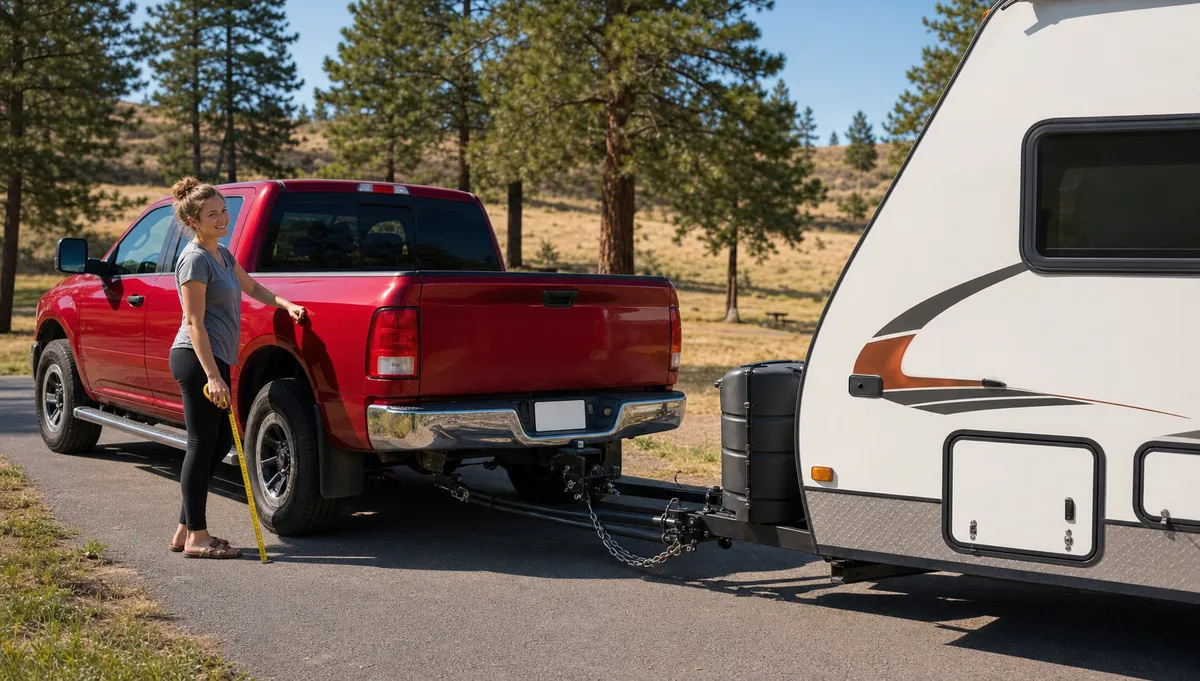
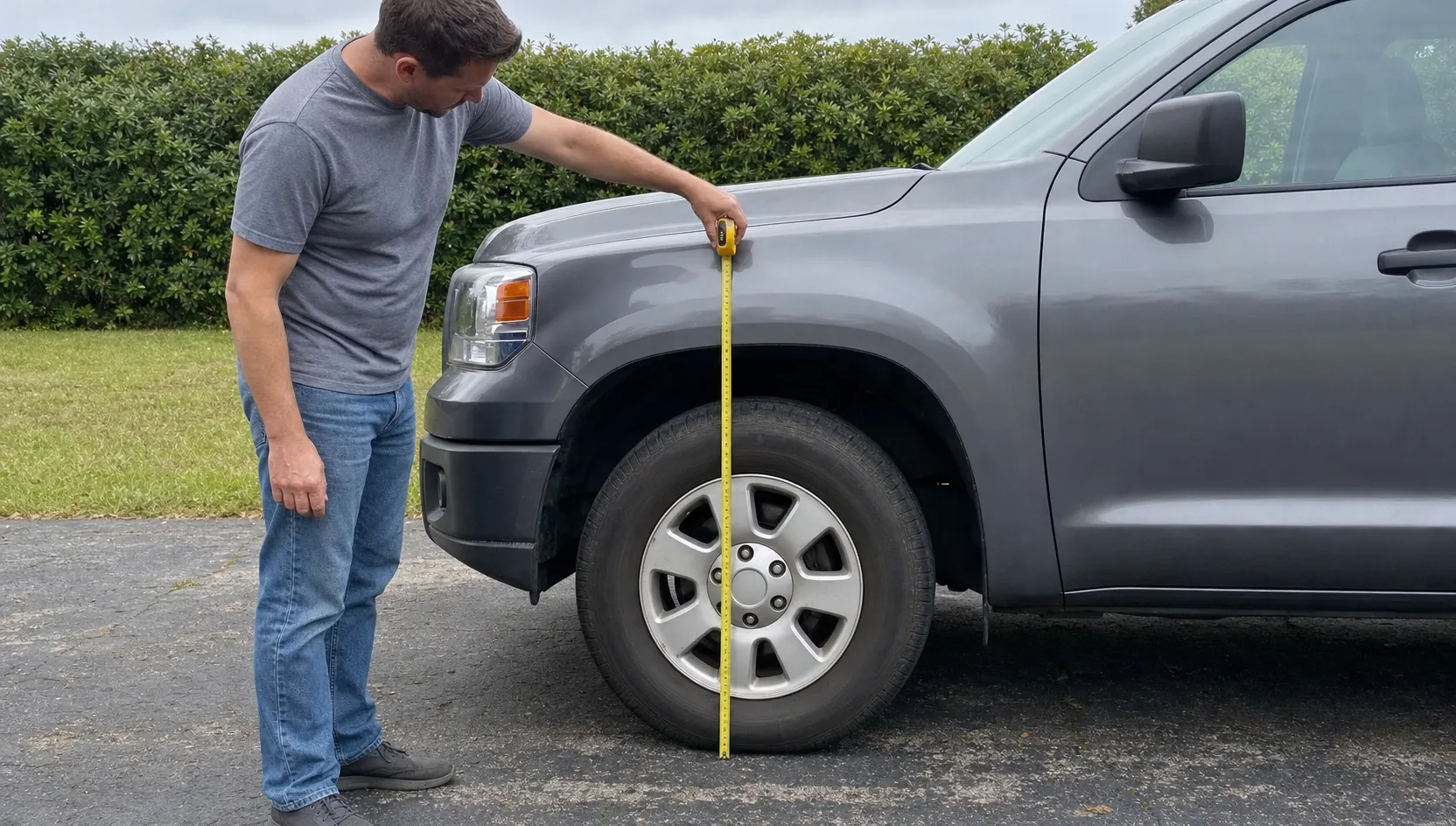
Park the loaded truck on level ground with no trailer attached. Measure from the ground to the top of the front wheel opening on the fender, and write it down as H1. Ford and Ram owner’s manuals both start this way.
Now couple the trailer without the spring bars and measure the same spot again, which gives you H2. The number will be higher, because the trailer lifts the front. That gap is the weight your hitch has to bring back.
Know Your Truck’s Target
Truck makers do not agree on how much of that gap to close. Ford’s 2013 F-150 guide asks for a fender height halfway between H1 and H2, and Ram’s manual asks for the same on its 2500 and 3500. The table shows what PickupTrucks lists for recent half-ton trucks. With no number, Camping World says to cut the gap by at least half.
| Truck | Hitch advised for | Front load restored |
|---|---|---|
| Ford F-150 (2022) | Over 5,000 lb | About 50% |
| Chevy and GMC 1500 (2021) | 7,000 lb and up | About 50% |
| Ram 1500 (2022) | Over 5,000 lb | About 66% |
| Toyota Tundra (2021–2022) | Over 5,000 lb | 100% |

Subscribe to
Our Newsletter
By joining, you agree to receive emails.
See our Privacy Policy.
Tension the Spring Bars
Couple the trailer, attach the spring bars, and tension them with the lift chains. Fewer links lift more weight onto the front axle, and more links lift less. Use the same number of links on both sides, and keep the tongue jack from being fully retracted while you couple, so it still supports the trailer.
If the chains cannot reach your target, change the hitch head’s tilt with washers, as Lippert describes. The direction that helps depends on your hitch, so follow its manual. Re-measure after every change, and check that the trailer sits level or slightly nose down.
Weigh the Rig
Fender measurements get you close, and a scale confirms the result. A truck scale shows your axle weights, so you can compare them with the ratings on your truck’s door label and your trailer’s label. Our GVWR guide explains each number. Camping World also suggests that new owners ask a certified RV technician to set up and adjust the hitch.
Back Up With Care
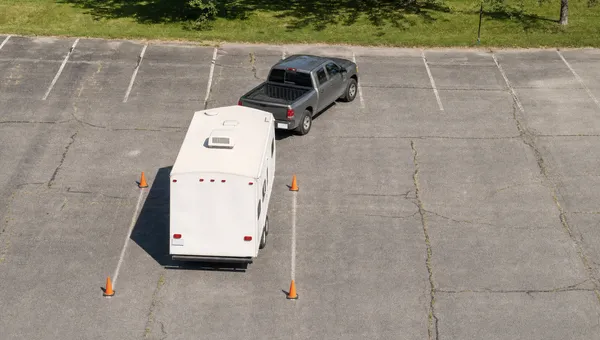
You can back up with the spring bars on as long as the trailer stays close to straight. A tight turn can bend a bar or pop one out, so etrailer advises taking the bars off first, and the friction sway control with them, if the turn is sharper than you could make going forward. Our trailer backing guide covers the steering method.
Common Hitch Mistakes
Skipping the manual. Truck makers set different targets, and your owner’s guide beats any rule of thumb. Follow it for your model year, and keep the hitch maker’s setup table with your trailer papers.
Sizing by trailer weight. Match the hitch to your loaded tongue weight first, then confirm the trailer weight rating fits too. Dry weights leave out water, gear, and the hitch itself.
Over-tensioning the bars. Ford warns against setting the bars so the rear bumper ends up higher than it was before you hitched. That defeats the hitch and can cause unpredictable handling.
Expecting more capacity. The hitch spreads weight, but every other rating stays the same. Stay under the lowest limit in your towing system.
Forgetting to re-check. Adjust the hitch again when you tow a much heavier or lighter load, and re-measure after every change. A new load can move your numbers.
Your Next Step
Find your owner’s manual rule, measure your tongue weight, and then measure H1 and H2 on level ground before your first trip. Repeat the same steps each time you hitch up, and ask a technician to check your first setup if the numbers feel confusing.