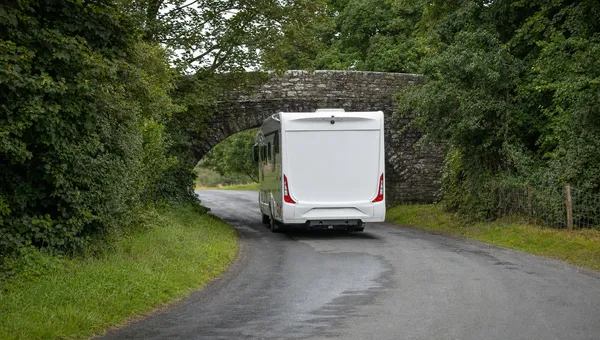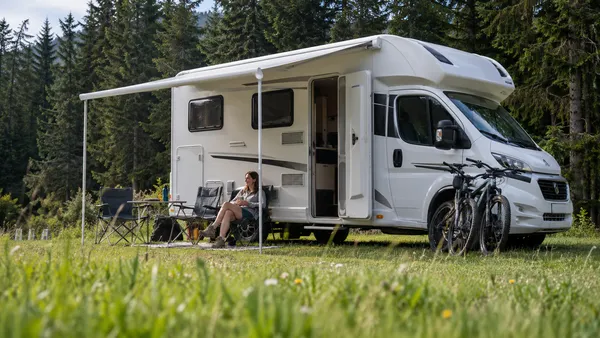

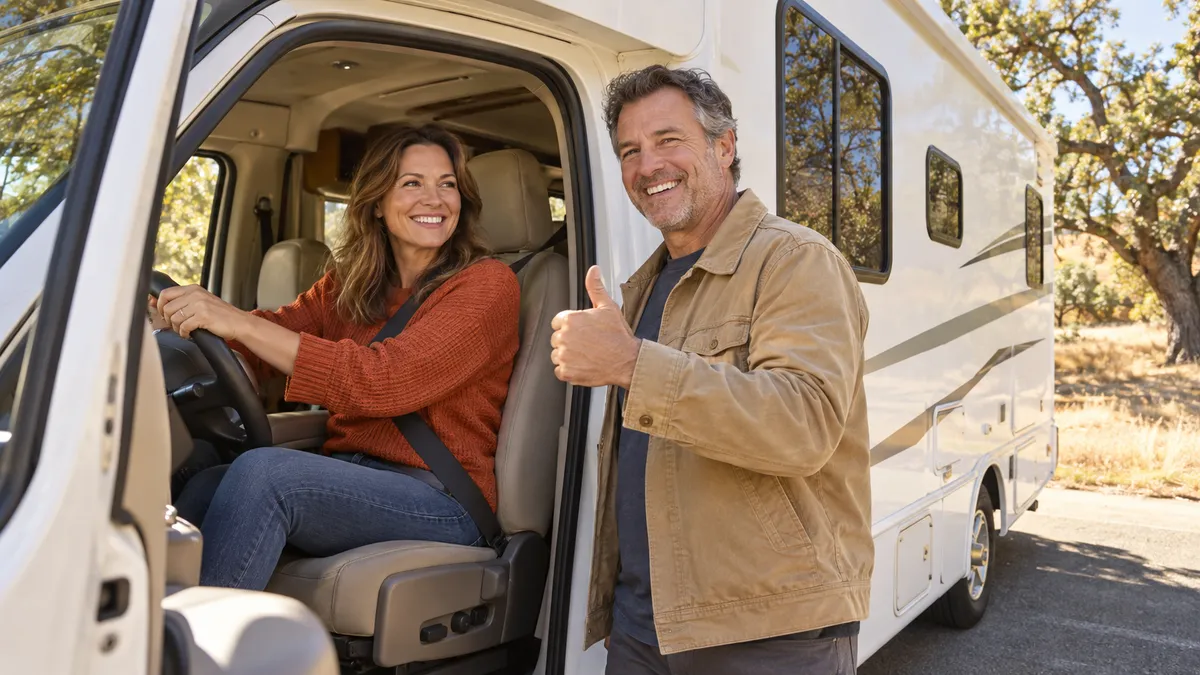
Driving an RV for the first time feels like steering a small building down the road. Your RV is taller, longer, and heavier than any vehicle you’ve driven, and you can’t see out the back, so everything feels bigger than it is. One hour in an empty parking lot and a few new habits take most of the fear away. A Class B drives like a big van, a Class A like a bus, and a trailer adds length behind you. Take it one step at a time.
Check Before You Pull Out
Run through this list before every drive. It takes two minutes and catches most departure mistakes. Towing a trailer? Check the hitch, the safety chains, and the trailer lights too.
- Reach the pedals and wheel without stretching.
- Check that both mirrors show your sides.
- Know your full height, roof items included.
- Pull in the steps and slides, then latch every door and bay.
- Unhook the power, water, and sewer lines.
- Check the pressure on the tire sticker or in your manual, then use the Tire Pressure Calculator to find the load on each tire.
Set Your Mirrors
Set your mirrors while the RV is parked on level ground, so you can see along both sides by moving only your eyes. If your mirrors have a small curved section, it widens your view but makes everything look farther away than it is. A backup camera is a great extra view, but it doesn’t replace your mirrors. Check both before you move.
Find Your Forward Blind Spot
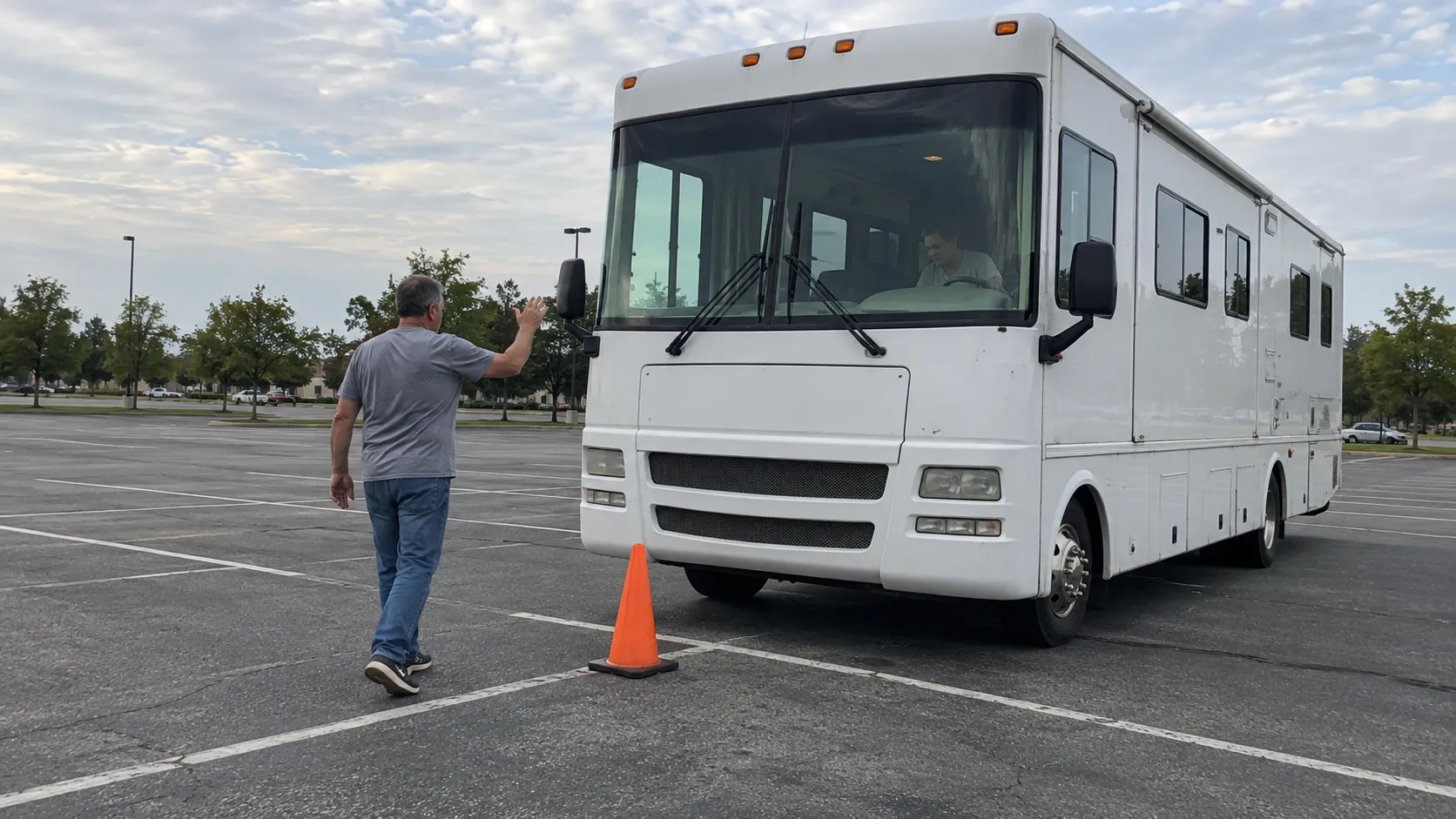
Winnebago suggests parking in an empty lot and having a helper walk backward in front of the hood until you first see their feet. Mark that spot, and you know how much road disappears in front of you. Repeat the test whenever you drive a different RV.
Practice in an Empty Parking Lot
An hour in an empty lot teaches you more than any article. Early Sunday morning works well, because nobody is around. Bring a helper and a few cones or boxes as markers, so you can see exactly where your RV ends.
Starts, Stops, and Turns
Start with gentle starts and stops, then try braking a little earlier each time. Make wide, slow turns around a cone and watch where the back of your RV goes.
Lines, Markers, and Backing
Follow the painted lines with the same gap on both sides in your mirrors, then pull up beside a cone to learn where your front ends. Finish by backing up straight with a spotter. When the lot feels boring, you’re ready for a quiet road.
Turning Without Hitting Anything
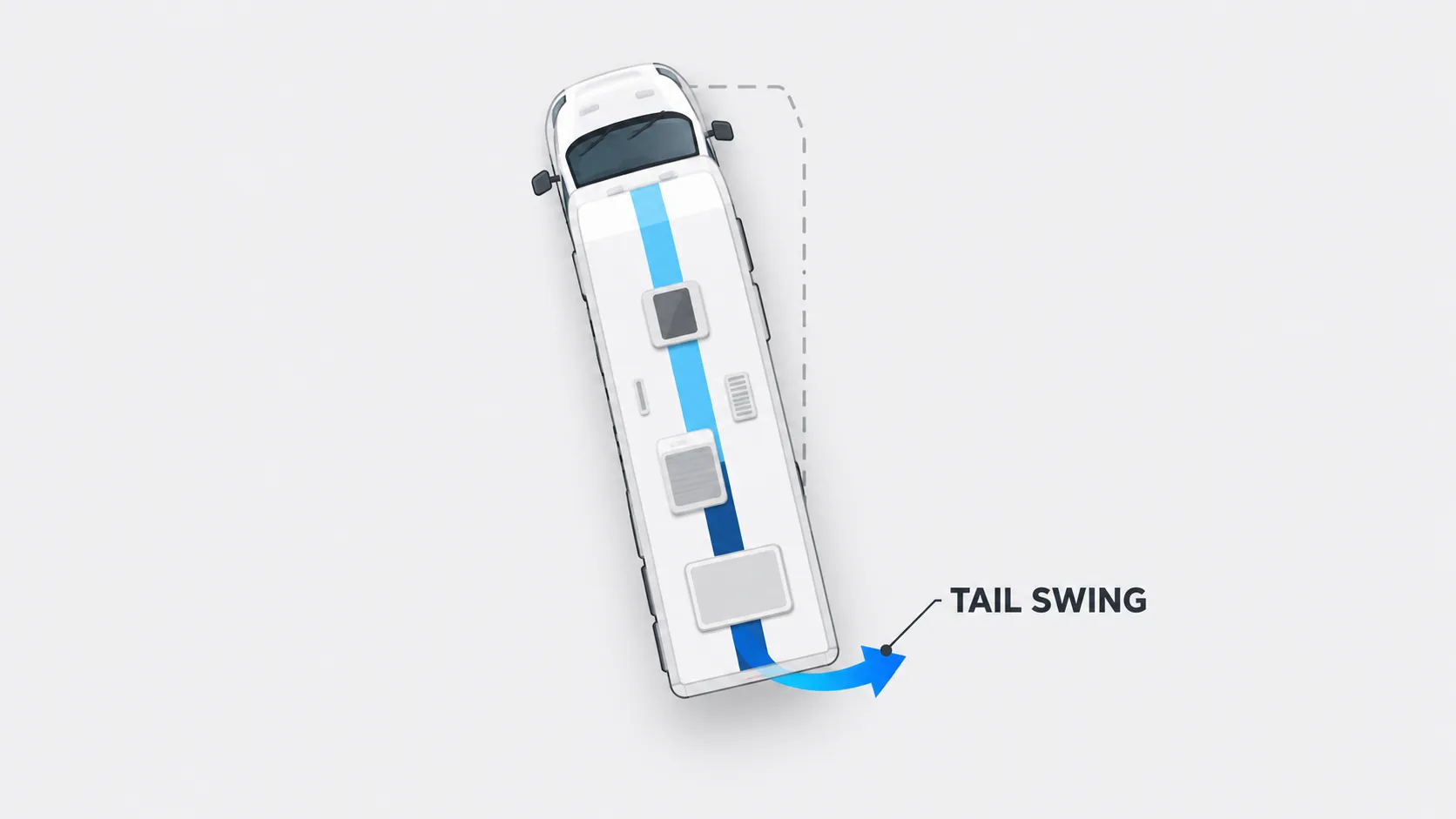
When you turn, the back wheels follow a tighter path than the front, and the rear overhang swings out the opposite way. That swing is called tail swing. On some RVs it can reach more than 30 inches, according to RV Travel, which is enough to clip a gas pump barrier.
Measure Your Tail Swing
You can measure your tail swing in the lot. Park next to a painted line, turn the wheel fully away from it, creep forward, and have your helper measure how far the rear sticks out.
Take Turns Wide
On the road, go straight a little longer than you would in a car. Wait until your front wheels pass the corner, then swing wide and watch your mirror.
Fuel Stops and Parking
Plan fuel stops before your tank runs low, and fill up at a quarter tank. Choose big stations and truck stops with wide entrances.
Remember tail swing when you pull away from the pump. At stores, park at the far end of the lot, where you have room to turn. At campgrounds, ask for a pull-through site on your first trips, so you don’t have to back in.
Backing Up With a Spotter
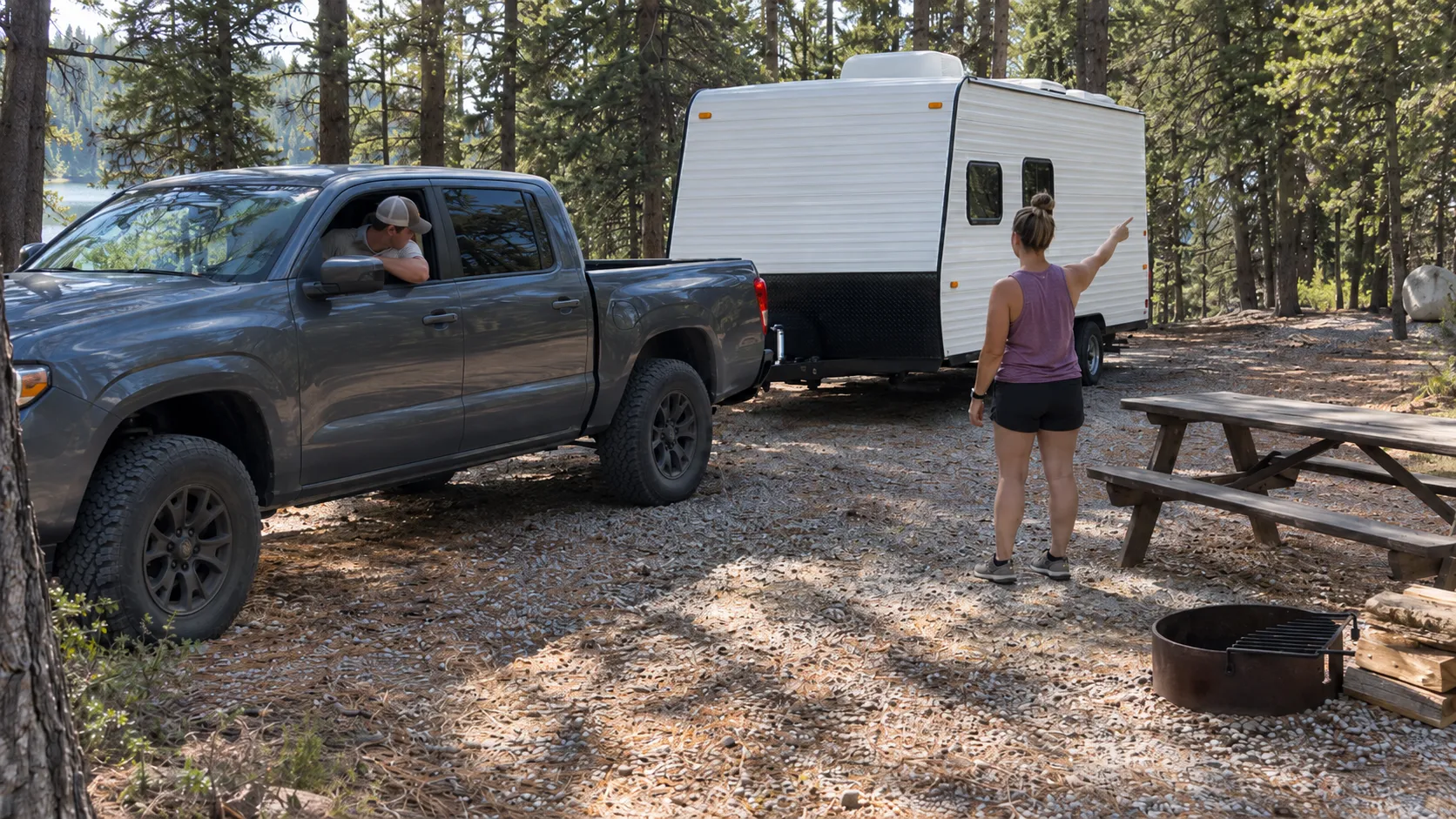
Before you back up, get out and look for posts, low branches, and anything on the ground. Then back up slowly, with a spotter watching the rear.
Agree on three hand signals first: left, right, and stop. If you lose sight of your spotter in the mirror, stop right away and get out to look.
Braking and Following Distance
RVs are heavy, so they need more road to stop. Brake earlier and more gently than in a car, and start slowing well before stop signs and red lights. The Stopping Distance Calculator shows how speed changes it. On long downhills, use the lower gears described in your owner’s manual instead of riding the brakes.
Leave Enough Space
The FMCSA teaches truck drivers to leave one second for every 10 feet of vehicle length below 40 mph, plus one more second above 40 mph. An RV is not a commercial truck, but the same math is a good starting point.
| RV length | Under 40 mph | Over 40 mph |
|---|---|---|
| 20 ft | 2 seconds | 3 seconds |
| 30 ft | 3 seconds | 4 seconds |
| 40 ft | 4 seconds | 5 seconds |
Count Your Seconds
Double the gap in rain, fog, or heavy traffic. To count it, pick a fixed object like a sign. When the car ahead passes it, count “one-thousand-one, one-thousand-two” until you reach it. Practice on an easy road until the count feels automatic.
Subscribe to
Our Newsletter
By joining, you agree to receive emails.
See our Privacy Policy.
Lanes and Passing
Stay in the right lane unless you’re passing, and drive at a speed that keeps you in control, even if traffic wants to go faster. Keep both hands on the wheel.
Pass only when you have clear road and plenty of room to pull back in, because a long RV needs more space to move over than you expect. Signal early, and move over smoothly.
Driving in Wind
Wind surprises most first-timers. A tall RV catches gusts like a sail, and a strong one can push you toward the next lane or the shoulder.
Check the forecast, and move your trip if strong winds are predicted. If gusts start pushing you around, slow down and pull off at the next safe exit or rest area.
Bridges and Big Trucks
Be extra careful on bridges and next to big trucks. A truck can block the wind and then release it, and as RV LIFE explains, that sudden change can make you overcorrect and drift. Give trucks extra room, so you have space to correct.
Your First Short Drive
Start short. Pick a weekday morning with light traffic, wide roads, daylight, and a destination an hour or two from home. Use an RV-specific navigation app to avoid low bridges and tight turns, and stick to roads you already know.
Drive as a Team
Do one more walk-around before you leave, and look at the tires, the hitch, and the lights. Driving with a partner? Agree on short phrases like “stop” or “turn coming in half a mile,” and decide that either of you can ask to pull over.
Build Up Slowly
For longer trips, our first-trip rules include the 2-2-2 rule: no more than 200 miles of driving a day, a stop every two hours, and arrival by 2 PM. Add a little more distance on each trip as your confidence grows, and take a break whenever you feel tense.
Common First-Drive Mistakes
Turning too early. Start your turns later than you would in a car, or the back wheels will climb the curb. Keep checking your mirror until the whole RV is around the corner.
Following too closely. Count your seconds, and add more in bad weather. A longer gap gives you time to brake gently instead of hard.
Forgetting your height. Know your number and watch for low-clearance signs. The Height Clearance Calculator helps you work it out before you reach a low bridge.
Ignoring the wind. Check the forecast before you leave, and slow down when gusts start pushing you around. Pull off at the next safe spot if it gets worse.
Driving tired. An RV needs more attention than a car, so stop when your focus slips. A short break at a rest area costs far less than a mistake at highway speed.
Your Next Step
You don’t need to be a perfect driver on day one. You need a calm hour in a parking lot, a few new habits, and a short first drive. When you’re ready for the bigger picture, our beginner’s guide covers choosing an RV, costs, hookups, and more.