


The best RV tools answer one worry fast: Can I afford this trip, will I fit under that bridge, and is my truck overloaded? Our free RV calculators cover costs, clearance, tires, towing, and power, so you can check the numbers in minutes instead of guessing. This guide shows what each tool does and when to reach for it.
Which RV Calculator Do You Need First?
Start with the question that worries you most, because each tool answers one question. Find your situation in the table, then jump to that section for the details.
| Your situation | Start with |
|---|---|
| Planning a trip budget | Trip Cost, then Fuel Cost |
| Shopping for an RV loan | Loan Calculator |
| Heading under a low bridge | Height Clearance |
| Checking tires before a trip | Tire Pressure, then Stopping Distance |
| Pairing a truck and a trailer | Towing Capacity, Payload, Tongue Weight |
| Camping without hookups | Solar, Battery Runtime, Generator Size |
Trip and Fuel Costs
Money questions come first for most beginners, and two tools cover the trip itself. Fuel is the part you can calculate closely, and the rest of the budget gets easier once you know it.

RV Fuel Cost Calculator
The RV fuel cost calculator turns miles, MPG, and fuel price into a trip total. Pick your RV class for a typical MPG, then set your gas or diesel price. At 500 miles, 10 MPG, and $4.50 a gallon, you burn 50 gallons and spend $225. Our gas mileage guide explains what moves your MPG up or down, from speed to towing to weight.
RV Trip Cost Calculator
The RV trip cost calculator adds fuel, campsites, and food and fun into one budget. A couple in a Class C driving 1,000 miles over 7 nights spends about $1,390 at a moderate style, or roughly $200 a day. RJourney puts a family of four at $120 to $250 a day when they own the RV, so your own numbers matter.
RV Loan Calculator
Financing starts with the monthly payment, and the RV loan calculator shows it from the price, down payment, interest rate, and term. A $60,000 RV with 20 percent down at 8 percent over 10 years costs $582 a month and about $21,885 in interest.
Term makes the biggest difference. On the same $48,000 loan, a 20-year term drops the payment to about $401 but costs $48,358 in interest. Credit Karma puts RV loan rates at roughly 4.5 to nearly 18 percent, so try a few rates before you talk to a lender.
Clearance and Stopping Room
Two checks protect your roof and your bumper: how tall you are and how far you need to stop. Run both before any travel day with older bridges, mountain roads, or rain in the forecast, since those are the days when a wrong guess costs the most.
RV Height Clearance Calculator
Enter your RV height and a posted clearance, and the height clearance calculator shows whether you fit, with a safety margin of 6 inches, 1 foot, or 2 feet. Roadtrippers suggests subtracting 6 inches from the posted height. Our clearance guide shows how to measure.
RV Stopping Distance Calculator
The stopping distance calculator shows how many feet you need from 20 to 80 mph on a dry or wet road, level or downhill. At 60 mph that is about 570 feet dry and 915 feet wet. The FMCSA tells truck drivers to cut speed by one-third on wet roads.
RV Tire Pressure Calculator
Your tires carry everything, and the tire pressure calculator turns your scale weights into the load to look up in your tire maker’s chart. It gives a load and never a PSI, because every tire maker publishes its own table. Michelin says to weigh each axle end and use the heaviest end for the whole axle. Our tire pressure guide covers the rest.
Towing and Weight Limits
Towing is where beginners get nervous, because three separate limits can stop you: the tow rating, the truck’s payload, and the weight on the hitch. Passing one does not pass the others, so run all three before you hitch up.

RV Towing Capacity Calculator
The towing capacity calculator checks your trailer’s weight against your vehicle’s tow rating at 80, 90, or 100 percent. Many RVers stay at or under 80 percent, which turns a 9,000 lb rating into 7,200 lb, and Jalopnik calls that a guideline and not a manufacturer rule. Enter the trailer’s GVWR, not the dry weight.
RV Payload Calculator
Payload often runs out before towing capacity does. The payload calculator checks whether your truck can carry your family, your gear, and the trailer’s tongue weight, It tells you if you are Within Payload, Close to the Limit, or Overloaded, and it shows the heaviest trailer your payload allows for your setup.
RV Tongue Weight Calculator
Tongue weight is the downward force a trailer puts on your hitch. The tongue weight calculator shows your target range, or checks a number you measured. Lippert puts the target for most setups at 10 to 15 percent of the trailer’s weight.

Subscribe to
Our Newsletter
By joining, you agree to receive emails.
See our Privacy Policy.
RV Solar Calculator
Camping without hookups means you make your own power. The solar calculator turns your daily watt-hours and sun hours into a panel count, so 1,500 Wh a day with four sun hours means six 100 W panels. Enter your own numbers to see how many your RV needs.
It counts a panel at 70 percent of its rated power, a cautious planning factor. RV electrical expert Mike Sokol told RV Travel readers to expect 300 to 400 Wh a day from each 100 W, so your estimate has a cushion. Our boondocking guide explains the bigger picture.
Battery and Generator Power
Solar needs a place to store energy, and a generator covers the days the sun does not. These two tools help you size both, and they work best next to the solar calculator.
RV Battery Runtime Calculator
How long will your batteries last? The battery runtime calculator turns amp-hours, battery type, and watts into hours. A 200 Ah lead-acid battery runs a 100 W load for about 12 hours, and lithium runs longer because more of it is usable.
RV Generator Size Calculator
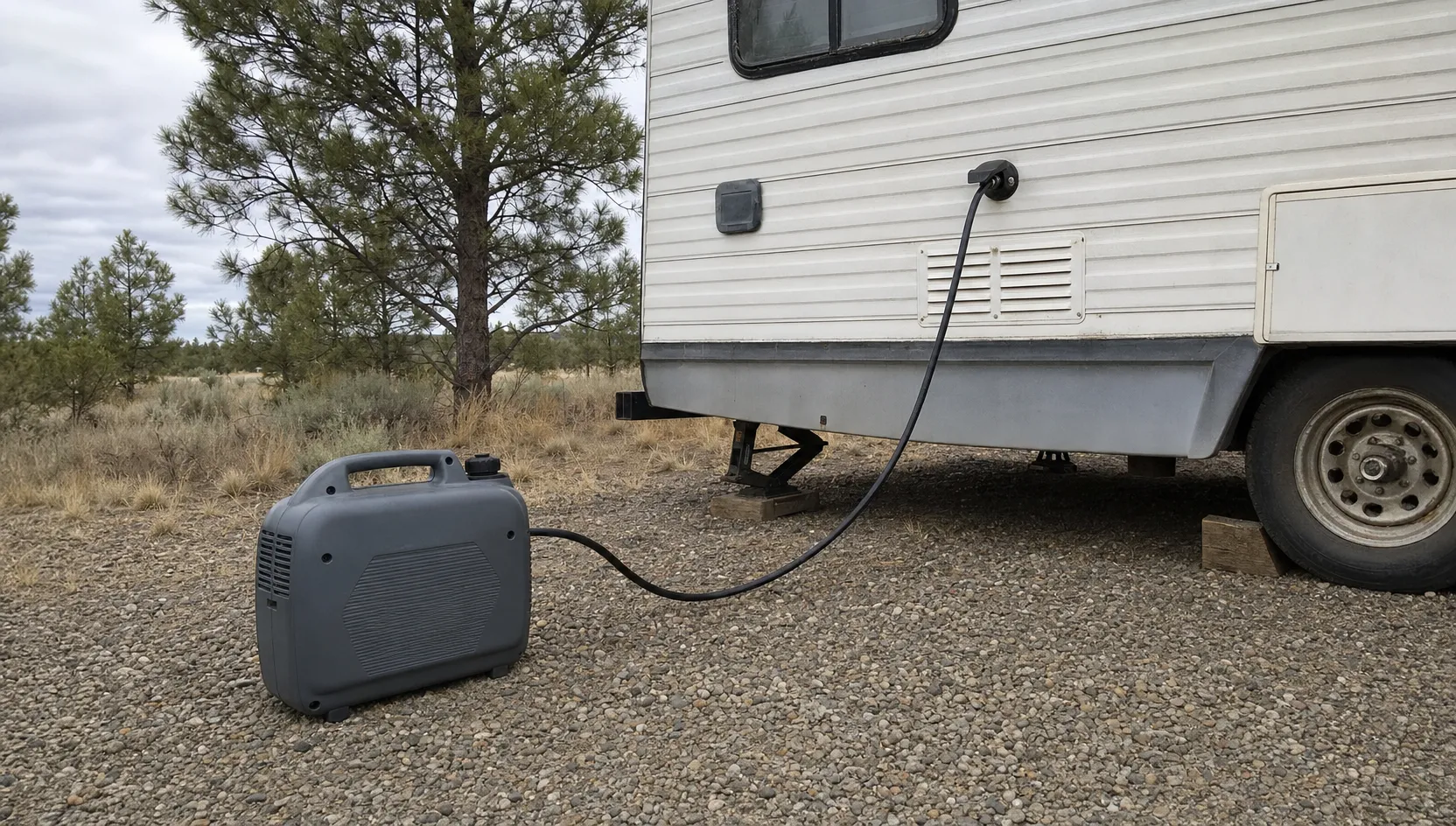
The generator size calculator tells you what size to shop for. With one 13,500 BTU air conditioner and 600 other watts, it suggests about 4,500 starting watts. It adds a cushion for altitude, because RV Travel says engine power drops 3.5 percent for every 1,000 feet above 500 feet, which matters in the mountains.
How the Tools Work Together
On a first trip, start with the trip cost and fuel tools to set your budget. Then check the trailer against your truck with the towing, payload, and tongue weight tools, and weigh your RV for tire pressure. Before you leave, check your height and your stopping distance for the speed you will drive that day, and write the results down.
These tools give you a fast first answer, not a final one. Your owner’s manual, your tire maker, and a public scale have the last word, so use the calculators to know what to check.
Check Before You Go
Run through these questions before every trip. Each one points to a calculator above, so you know where to go when an answer is no.
- Do you know what the trip will cost for fuel, campsites, and food?
- Do you know your RV’s highest point, including the roof A/C?
- Have you weighed your RV and checked the load on each axle end?
- Are you leaving enough room for your speed on wet or downhill roads?
- Are your trailer weight, payload, and tongue weight within limits?
- Will your solar, battery, or generator cover a night without hookups?
Common Mistakes With RV Calculators
Guessing the inputs. A calculator is only as good as its numbers, so measure your height and weigh your rig instead of estimating from a brochure.
Using dry weight. Dry weight is the empty trailer, and you never tow it empty. Use the GVWR or a loaded scale reading for every towing check.
Checking only one limit. A trailer can pass the tow rating and still overload the truck’s payload or hitch, so check all three towing limits.
Skipping the cushion. The result is a planning number. Leave room for hills, wind, heat, and heavier loads than you expect, because a cushion costs little.
Your Next Step
Pick the tool that matches your biggest worry and run your numbers today, then add the others as your setup grows. Thinking about buying an RV? Our ownership costs guide adds up the yearly numbers, and our beginner’s guide explains the terms in plain English.