
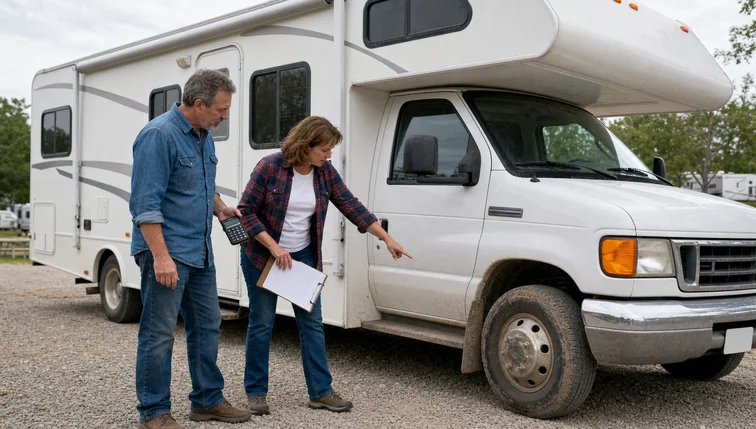
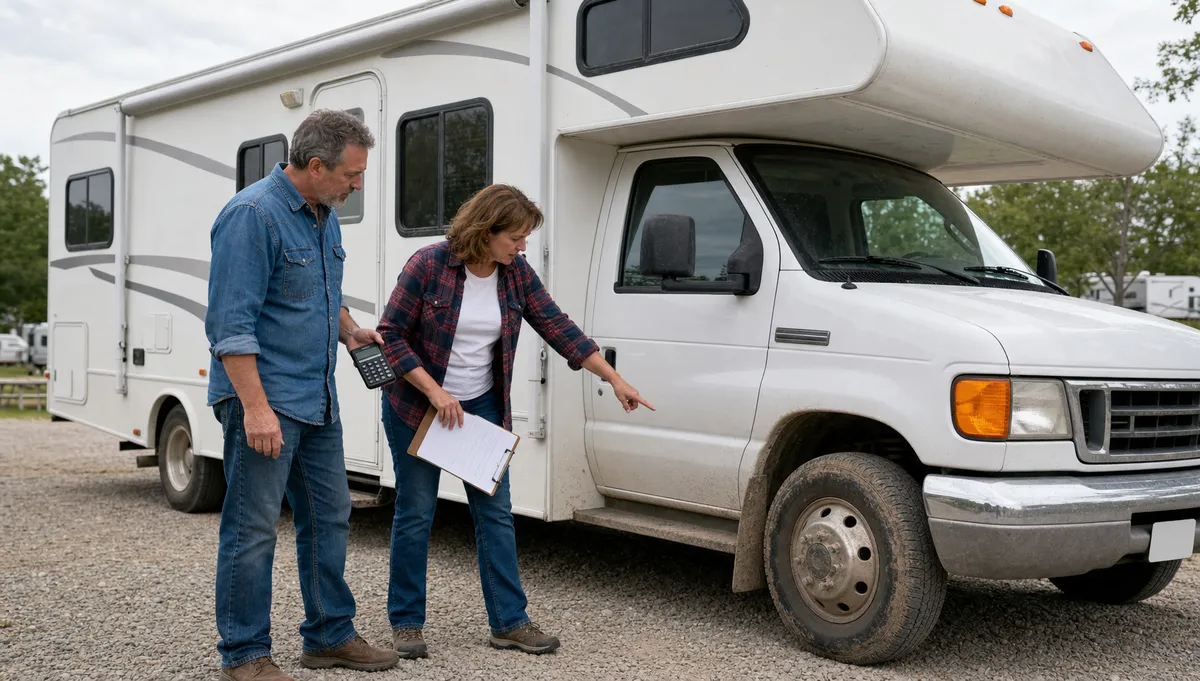
RV value comes down to three numbers: what the book says, what sellers ask, and what a buyer will pay. The old NADA guide now belongs to J.D. Power, and Kelley Blue Book doesn’t cover RVs at all. This guide gives you a three-step method: a J.D. Power baseline, RV Trader comparisons, and a condition adjustment. You’ll finish with a price range you can defend, plus a worked example with made-up numbers.
Why KBB Skips RVs
Kelley Blue Book doesn’t value RVs, according to Outdoorsy, which says its coverage stops at cars, trucks, SUVs, and motorcycles. The RV equivalent was the NADA guide, and J.D. Power took over that business in 2015, as Camping World explains. People still search for “NADA RV value,” and J.D. Power’s RV page still carries that name in its title.

The method has three steps. Start with the J.D. Power book value, check it against listings on RV Trader, then adjust for your RV’s condition. No single number is final, and RV Travel says book value is turning into a starting point instead of the last word.
RV Value From J.D. Power
Open the J.D. Power RV values page and enter your RV’s details. It returns a suggested list price, a low retail value, and an average retail value, and only the last two reflect today’s market. Have these details ready before you start:
- Your RV type (see our types of RVs if you’re unsure)
- The maker, the model year, and the exact model
- Factory options, which adjust the estimate when you add them
- Your odometer mileage, if yours is a motorhome
- Your zip code
Check RV Trader Comps
Search RV Trader for your make, model, and year, then filter by price and distance to find five or more RVs like yours. Write down each asking price, and note how long each listing has stayed up, since a slow listing suggests the price is too high.
An asking price is what a seller hopes to get, not what the RV sells for, as Camping World points out. RV Trader also has an RV values tool that uses J.D. Power data, so treat its number as the same book value you already have, not as a second opinion.
Book, Asking, and Offer
The three numbers measure different things. On November 28, 2026, J.D. Power listed a 2021 Coleman by Dutchmen M-17B at a $16,232 suggested list price, a $5,750 low retail value, and a $6,900 average retail value, so the new-RV sticker price says little about resale.
| Number | What it tells you | Where to find it |
|---|---|---|
| Book value | A guide estimate from national data | J.D. Power |
| Asking price | What sellers hope to get | RV Trader |
| Dealer offer | What one buyer will pay today | Dealers, Good Sam |
When Book Value Lags
Book values can trail a moving market. RV Travel reports that dealers now weigh recent auction prices, asking prices, regional demand, local inventory, and how long similar RVs sit on lots, with book value as one input among several.
In September 2026, RV Travel also relayed a warning from National Powersport Auctions that average wholesale prices in most categories sit well below guidebook levels. That’s a reason to expect dealer offers below the book numbers, and a reason to lean on your comps.
Adjust for Condition

Roof and seals. Check the roof, the sealant lines, and the ceiling near vents for stains or soft spots. Water damage scares buyers, so repair small leaks before you list your RV.
Tires and brakes. Old tires and worn brakes are a bill the next owner has to pay, and a buyer will take it off the price. Fix what you can before photos.
Service records. Camping World lists detailed service records and transferable warranties among the things that make buyers more confident. Keep a folder ready.
Upgrades. The book value doesn’t price the upgrades you’ve added. Look for listings with similar upgrades to judge what buyers pay for them.
Region and season. Demand tends to peak in spring and summer, and two near-identical RVs can differ in value by location. Check listings near you, and sell when buyers are shopping.

Subscribe to
Our Newsletter
By joining, you agree to receive emails.
See our Privacy Policy.
A Worked Example
These numbers are made up to show the method, so swap in your own. Say J.D. Power shows a 2019 travel trailer at $22,000 low retail and $26,000 average retail, and five similar RV Trader listings ask $23,500, $24,900, $25,500, $26,900, and $28,000. The middle listing is $25,500, which sits between the two book values.
Your trailer has full service records and good tires, but a small stain by one vent. The records keep it near the middle of the comps, and the stain means buyers will ask for less. List at $25,500 and plan to accept about $23,500, still above the $22,000 low retail.
Private Sale or Trade-In
Selling privately lets you price near the comps, but you handle the photos, calls, and paperwork. Camping World notes that a dealer trade-in saves you that time and effort, but the offer usually comes in lower than an asking price.
A dealer’s trade-in offer in this example will likely land below $22,000, because RVshare says actual trade-ins usually come in under low retail. If you sell privately to a buyer who finances, the lender may rely on book value, and a price well above it can mean a larger down payment. Buyers can test that payment with our RV loan calculator.
Get a Dealer Offer
A valuation tells you what your RV could sell for, and an offer tells you what someone will pay now. The Good Sam RV Valuator, which belongs to Camping World, gives a price range and then an official offer that stays valid for seven days. Ask at least one other dealer too, because RV Travel advises getting offers from more than one buyer.
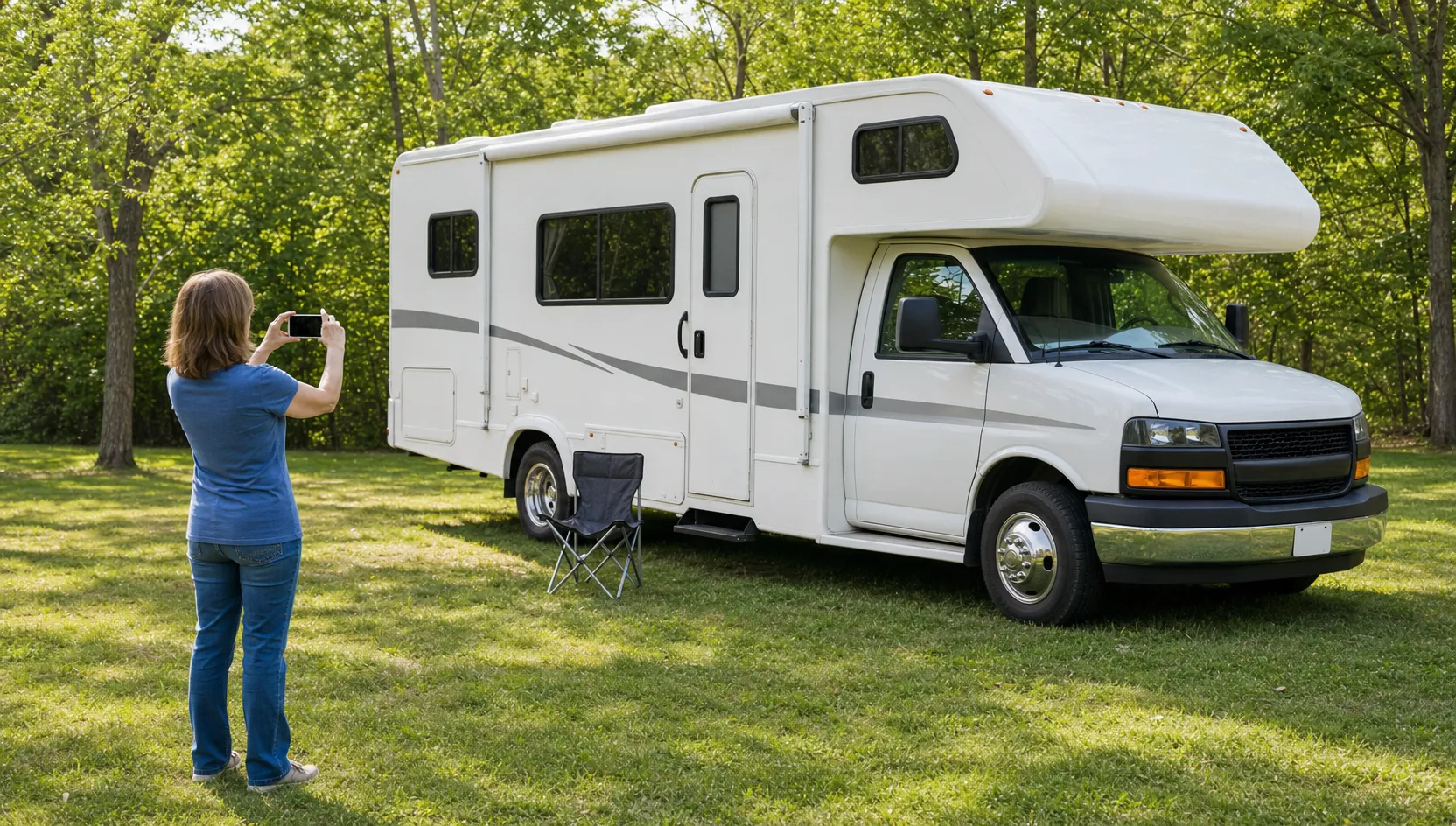
Dealers build in the cost of reconditioning, carrying the unit, and the risk that its value drops before it sells, which is why offers run below asking prices. Our RV prices guide shows how to treat a trade-in as its own number when you buy your next RV.
Your Next Step
Pull your J.D. Power numbers, collect five RV Trader comps, and adjust for condition, and you’ll have a price range you can defend. If you’re still deciding whether to sell, our RV ownership costs guide shows what depreciation and upkeep add up to each year.