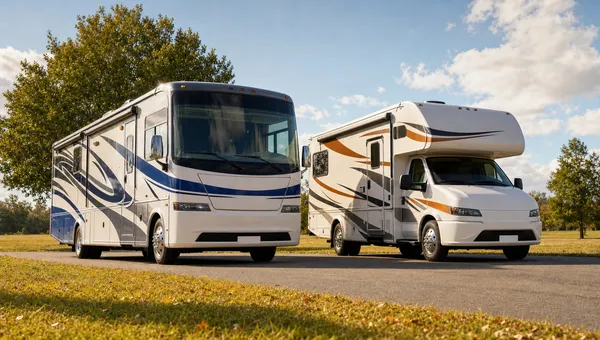

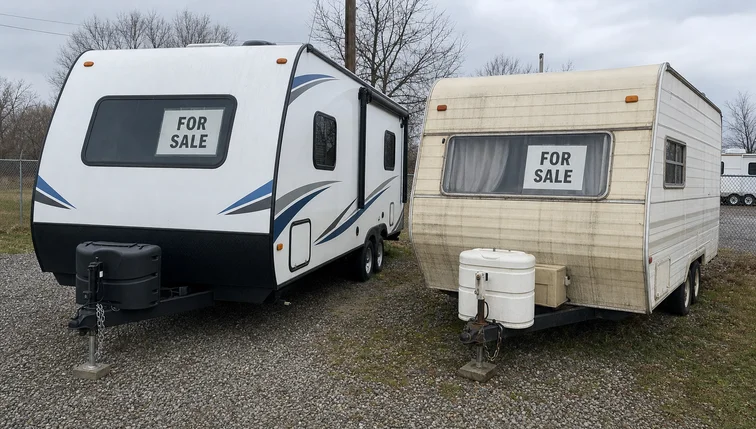
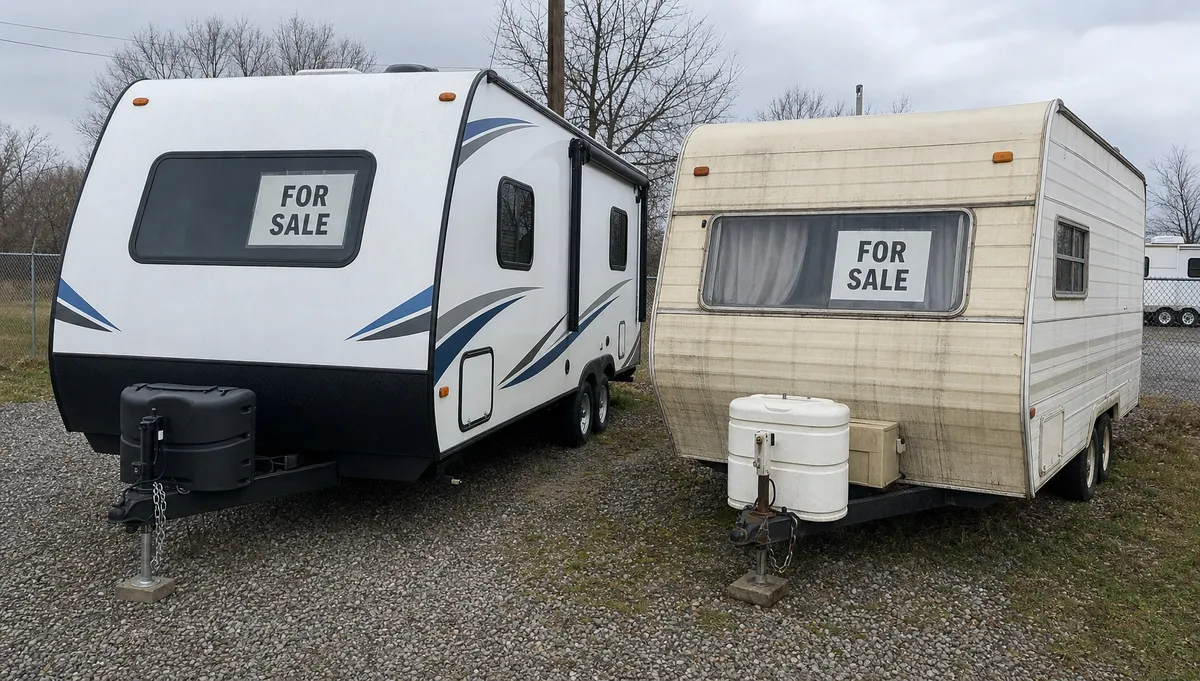
RV prices run from about $10,000 for an entry-level travel trailer to $500,000 for a top diesel motorhome, according to Camping World. The type you pick sets most of the price, and the sticker is only part of what you pay at the dealer. This guide shows typical new and used prices by type, what moves them, and a sample out-the-door total, so you can budget before you shop and avoid surprises at the closing table.
New RV Prices
Camping World splits travel trailers and fifth wheels into entry-level, mid-range, and luxury tiers, which shows how far one type can stretch. Brand, size, and features decide where a rig lands, and our RV types guide explains what each type gives you for the money.
| RV type | Typical new price |
|---|---|
| Entry-level travel trailer | $10,000 to $30,000 |
| Mid-range travel trailer | $30,000 to $50,000 |
| Luxury travel trailer | $60,000 to $200,000+ |
| Entry-level fifth wheel | $35,000 to $60,000 |
| Mid-range fifth wheel | $60,000 to $100,000 |
| Class C motorhome | $55,000 to $110,000 |
| Class B camper van | $90,000 to $200,000+ |
| Class A gas motorhome | $100,000 to $200,000+ |
| Class A diesel pusher | $200,000 to $500,000 |
Why Sources Disagree
You will see different ranges for the same type, because each site draws its tiers differently. Harvest Hosts lists new travel trailers at $10,000 to $60,000 and Class B camper vans at $80,000 to $165,000, while Camping World’s luxury tiers reach $200,000 and up for both, which stretches the top of the range.
Getaway Couple puts standard travel trailers and toy haulers at about $25,000 to $35,000 new. Treat any single range as a starting point, then check current listings for the exact model and year you want before you set your budget.
What Your Budget Buys
Camping World’s under-$30,000 guide says new RVs near $10,000 are limited. You are mostly looking at basic pop-up campers and a few entry-level teardrops, while older used trailers in good condition turn up often at that price. At $30,000 you reach the top of the entry-level market and the bottom of the mid-tier.
Move up the table and the type changes. About $50,000 buys the top of a mid-range travel trailer or an entry-level fifth wheel, Class C motorhomes begin around $55,000, and Class B camper vans start near $90,000.
New Versus Used
A new RV gives you a manufacturer warranty, the latest floor plans, and a unit nobody else has used. It also costs more, and Camping World notes that a new RV depreciates fastest.
A used RV costs less and often gets you more RV for the same budget. You take on its unknown history, so ask whether the dealer inspects and services used units before sale.
Used RV Prices
A used RV costs meaningfully less than a new one, mainly because the first owner absorbs the steepest depreciation, as Camping World explains. Our ownership costs guide has the depreciation numbers, so this section sticks to what used RVs sell for.
For a market snapshot, J.D. Power Values put the average standard travel trailer at $25,565 and the average Class A motorhome at $207,756 in March and April 2026. The report does not say whether those averages cover used units only, so use them as a guide, not a quote.
Used Price Checks
Compare each listing with RVs of the same type, age, and condition, because two used trailers with the same asking price can sit far apart in value. Ask for service records and the original paperwork, and check the date code stamped on each tire.
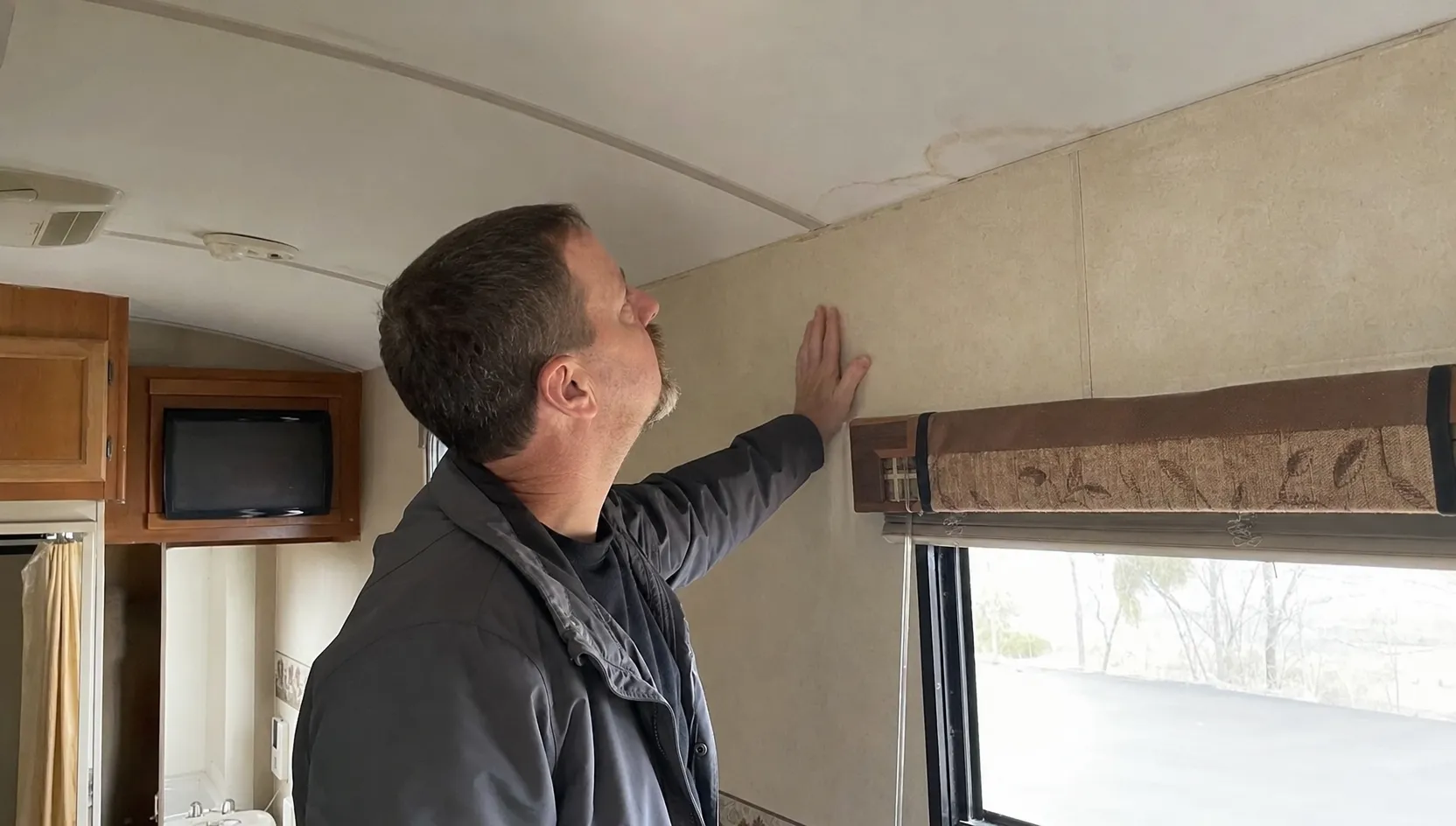
Water damage is the costly surprise. Press on the walls, look for stains or soft spots along ceiling seams and roof edges, and sniff for mustiness. For a bigger purchase, pay an independent RV inspector before you sign.
What Changes the Price
Two RVs of the same type can sit tens of thousands of dollars apart. These six factors drive most of the gap, so decide which ones you can flex.
- Size: longer rigs with more living space cost more.
- Tier: a luxury fifth wheel runs $90,000 to $250,000+, while an entry-level one starts at $35,000.
- Engine: a gas Class A starts around $100,000, and a diesel pusher starts at $200,000.
- Age: each year of age lowers the price, and condition adds or takes away more.
- Features: slide-outs, upgraded interiors, and extra equipment raise the price.
- Brand: the same layout can cost more or less depending on the maker.
Dealer or Private Seller
A dealer handles the paperwork, often arranges financing, and may back newer units with a warranty. In exchange, the price carries dealer fees and the dealer’s margin.
A private seller usually asks less, and you pay no dealer fees. You handle the title transfer and sales tax yourself, and the RV is typically sold as is. Confirm the seller holds a clear title with no loan on it, and check your state’s filing rules.
Beyond the Sticker Price
Camping World says the sticker price on an RV often leaves out sales tax, registration, and dealer fees. Know each one before you sign.
Sales tax. The rate depends on your state, so look it up before you set a budget.
Title, license, and state fees. Your state sets them, and they are added at signing.
Dealer fees. These cover freight, vehicle prep, and paperwork. Some dealers add them at closing, while Camping World’s ClearPrice program includes them in the advertised price.
Your out-the-door price. Ask every dealer for this number, and compare it instead of the sticker.
Sample Out-the-Door Total

Here is how a $25,000 entry-level travel trailer adds up. The extras below are sample numbers, not quotes, so swap in your own.
Add 6 percent sales tax ($1,500), $1,000 for freight, prep, and paperwork, and $250 for title and registration. Your out-the-door total comes to $27,750. Tax is the line that grows with the price, since the same 6 percent costs $3,600 on a $60,000 RV.
Sample Used Total
A $15,000 used trailer from a private seller carries no dealer fees. Add 6 percent sales tax ($900), $250 for title and registration, and $300 for an independent inspection, and the total comes to $16,450. These are sample numbers, not quotes, and your state’s tax rules and fees will differ from them.

Subscribe to
Our Newsletter
By joining, you agree to receive emails.
See our Privacy Policy.
Typical RV Loan Rates
LendingTree analyzed RV loan offers on its marketplace in the third quarter of 2026. Average rates came to 7.60 percent for new RVs and 7.66 percent for used ones, and the gap between credit tiers was small in that data.
Borrowers with scores below 580 may not qualify for RV financing at all. Terms run from 5 to 20 years, and the longest terms usually go to loans of $50,000 and up. Treat these numbers as a benchmark from one quarter, and compare quotes from a few lenders.
Down Payment and Trade-In
A larger down payment cuts the amount you borrow and the interest you pay. Camping World’s example uses 20 percent down, which is a handy target to plan around.
If you have a trade-in, ask for its value as a separate number and check it against listings for similar RVs. Settle the RV price first, then the trade-in, then the financing, so you can see exactly what each one costs you.
How Term Changes the Payment
Financing adds more than most buyers expect. Camping World’s example puts $5,000 down on the $25,000 trailer and finances $20,000 for 12 years at about 8.5 percent, which is roughly $222 a month and $31,968 in payments. Interest adds close to $12,000.
At the 7.60 percent new-RV average, our math on a $20,000 loan gives about $402 a month over 5 years, $238 over 10, and $187 over 15, with total interest of about $4,100, $8,600, and $13,600. Our RV loan calculator shows the payment for your own numbers.
Budget for Insurance
Insurance is a yearly cost you can price before you buy. Camping World lists typical annual premiums of $300 to $600 for a travel trailer, $500 to $1,000 for a fifth wheel, $1,000 to $3,000 for a Class C, and $1,500 to $4,000 for a Class A.
Your own rate depends on your state, your driving record, and the RV’s value, so get a quote before you commit. Storage and upkeep come on top, and you should check them next.
Set Your Budget
Start with the type, because that sets your price range. If you plan to tow, check your truck’s rating against the trailer first, and our GVWR guide explains the weight numbers on the label, so you buy a trailer your truck can pull.
Next, price the tier you can afford and ask two or three dealers for the out-the-door number. Run the monthly payment in the loan calculator, then add the yearly costs of insurance, storage, and upkeep before you decide.
Your Next Step
Pick one type and one tier, then write down the out-the-door price you would accept. If you are not sure which type fits, our beginner’s guide walks through the choice step by step, and renting one for a weekend is the cheapest way to test it.