
GVWR stands for gross vehicle weight rating, and it’s the most your RV is rated to weigh when it’s fully loaded. The manufacturer sets the number and prints it on a label, so you never have to calculate it. This guide explains what GVWR means, how it differs from dry weight, GCWR, and towing capacity, and where to find yours before you buy or tow.
What GVWR Means
GVWR is the maximum weight a manufacturer says a vehicle can carry safely, counting the vehicle itself. The federal vehicle safety rules define it as the loaded weight of a single vehicle, as specified by the manufacturer, in 49 CFR 571.3.
Everything inside counts toward it: the RV itself, fresh water, propane, gear, and in a motorhome, the people riding along. In a towable, the people ride in your tow vehicle, so the trailer’s GVWR covers only the trailer and what you load into it.
Think of GVWR as a ceiling. Your RV can weigh less than that number, but it should never weigh more, no matter how much gear you want to bring on a trip.
GVWR vs GVW
Gross vehicle weight (GVW) is what your RV weighs right now, and GVWR is the limit. You find the GVW by driving onto a scale, while the GVWR is already printed on the label. Your goal is simple: keep your actual weight under the rating.
Where to Find Your GVWR
On a travel trailer or fifth wheel, the federal label sits on the outside near the front on the driver’s side, according to Escapees. On a tow vehicle, it’s on the sticker inside the driver’s door sill. Motorhomes carry placards inside the coach.
If you can’t find the label, the owner’s manual or the manufacturer’s website has the number. Write it down before you shop, and compare it with the label on the exact RV you’re buying, not only the model name or the brochure.
GVWR vs Dry Weight
Dry weight, also called unloaded vehicle weight (UVW), is the RV as it left the factory. Under the RV industry’s terms, as published by Keystone RV, it leaves out cargo, fresh water, propane, and dealer-installed accessories.
So dry weight is where your RV starts, and GVWR is the limit it should never pass. A trailer with a 6,500-pound dry weight sounds easy to tow, but its GVWR may be 8,000 pounds, and your truck has to handle the number you’ll reach once you add water and gear.
Net Carrying Capacity
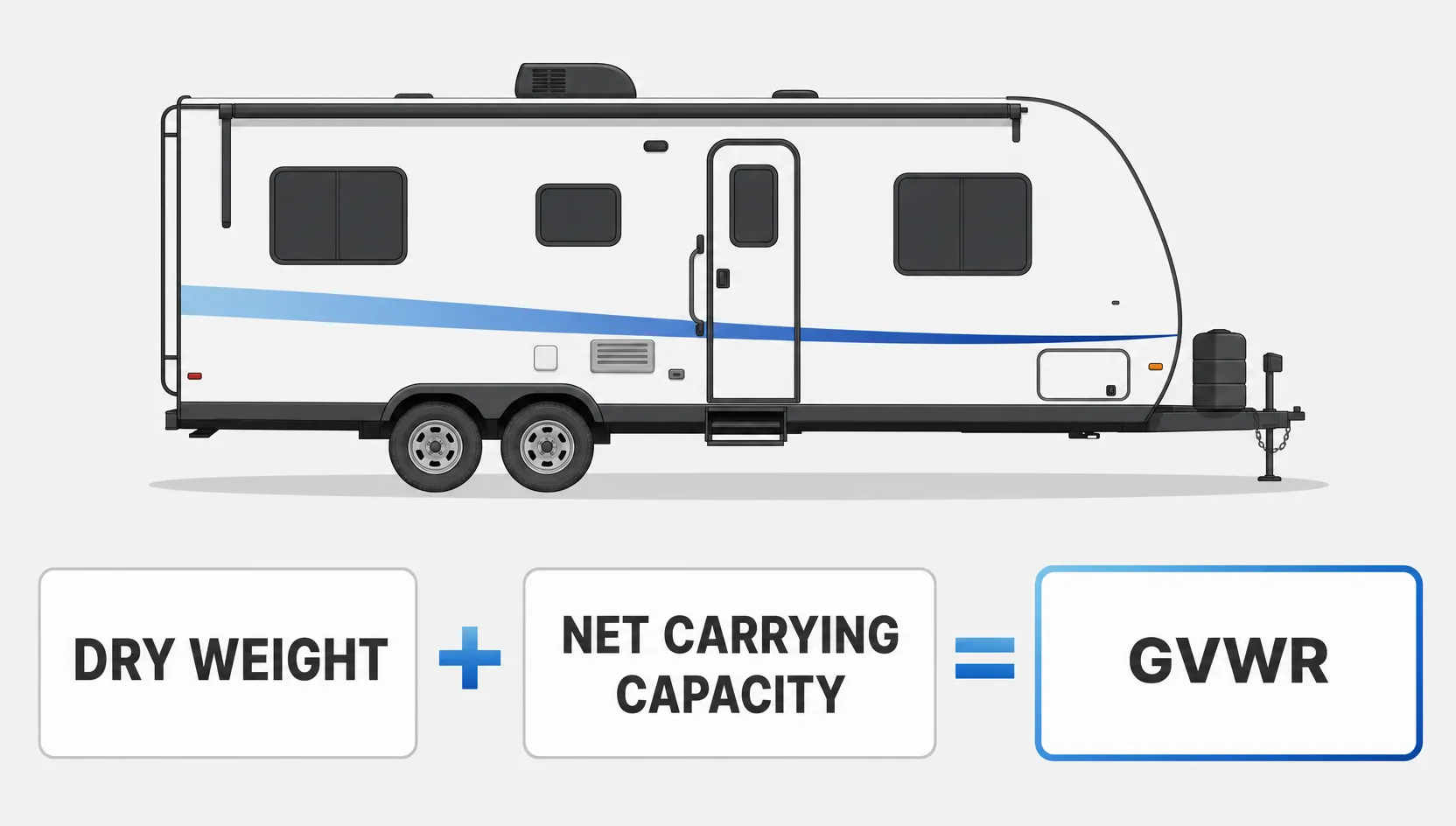
Net carrying capacity (NCC) is the weight you can add to the RV, and the formula is simple: GVWR minus dry weight. Keystone counts belongings, food, water, propane, tools, and dealer-installed accessories against it.
Say a trailer has a GVWR of 8,000 pounds and a dry weight of 6,500. That leaves 1,500 pounds for everything you add. A full 30-gallon fresh water tank uses about 250 of it, since water weighs about 8.3 pounds per gallon, leaving about 1,250 for food, clothes, and gear.
Your label may list cargo carrying capacity (CCC) instead, and that number is smaller. NIRV explains that CCC also subtracts the sleeping capacity weight, which is 154 pounds for each sleeping position, along with the fresh water and propane.
Motorhomes work a little differently. Their labels often list occupant and cargo carrying capacity (OCCC), which also counts the people on board, NIRV explains. Some coaches have only a couple thousand pounds of it, so people, a full water tank, and propane can use up a large share before you pack a single bag.
Weight Terms Compared
Weight labels use a lot of abbreviations, and they sit on different vehicles. This table shows which number answers which question.
| Term | What it means | Where to find it |
|---|---|---|
| GVWR | Most the RV may weigh loaded | Label on the RV |
| Dry weight | Weight as built, empty | Label on the RV |
| Net carrying capacity | GVWR minus dry weight | Simple math |
| GCWR | Truck and trailer together | Tow vehicle manual |
| Towing capacity | Most the vehicle can pull | Tow vehicle manual |
GVWR vs GCWR
GCWR, the gross combined weight rating, is the most your tow vehicle and trailer may weigh together when both are loaded. It’s a tow vehicle rating, so you find it in the truck’s owner’s manual and not on the trailer.
A motorhome has a GCWR too, and it covers the coach plus anything it tows, such as a car on a tow bar. In both cases the GCWR is a combined limit, while the GVWR covers one vehicle on its own, so check both numbers.
GVWR vs Towing Capacity
Towing capacity is how much a vehicle can pull, and GVWR is how much that same vehicle can weigh when loaded. They are separate ratings, and your truck has both. Compare your trailer’s GVWR with your truck’s towing capacity, since GVWR is the most the trailer can weigh.
Your truck’s own GVWR matters too, because tongue weight and everything in the cab and bed count toward it. Run both checks through our towing capacity calculator and payload calculator before you commit to a trailer.
Check Before You Buy
Run through this list when you compare an RV with your vehicle. It takes a few minutes and catches the most common weight mistakes before you sign.
- Find the GVWR on the label of the exact RV you’re buying.
- Subtract the dry weight to see its net carrying capacity.
- Compare the trailer’s GVWR with your truck’s towing capacity.
- Check your truck’s payload for tongue weight, people, and gear.
- For a motorhome, look up the occupant and cargo capacity.
- Plan to weigh the rig once it’s loaded for a trip.

Subscribe to
Our Newsletter
By joining, you agree to receive emails.
See our Privacy Policy.
What Happens If You Exceed It
Going over your GVWR strains everything the RV was built to carry. Escapees lists worn tires, weaker braking, poorer handling, and a higher accident risk among the consequences, and it adds that you may face legal and financial liability.
Overweight rigs are common. Escapees cites SmartWeigh data showing about 57 percent of the RVs it weighed were overweight in some area, which is why a quick scale visit pays off.
Weigh Your Rig
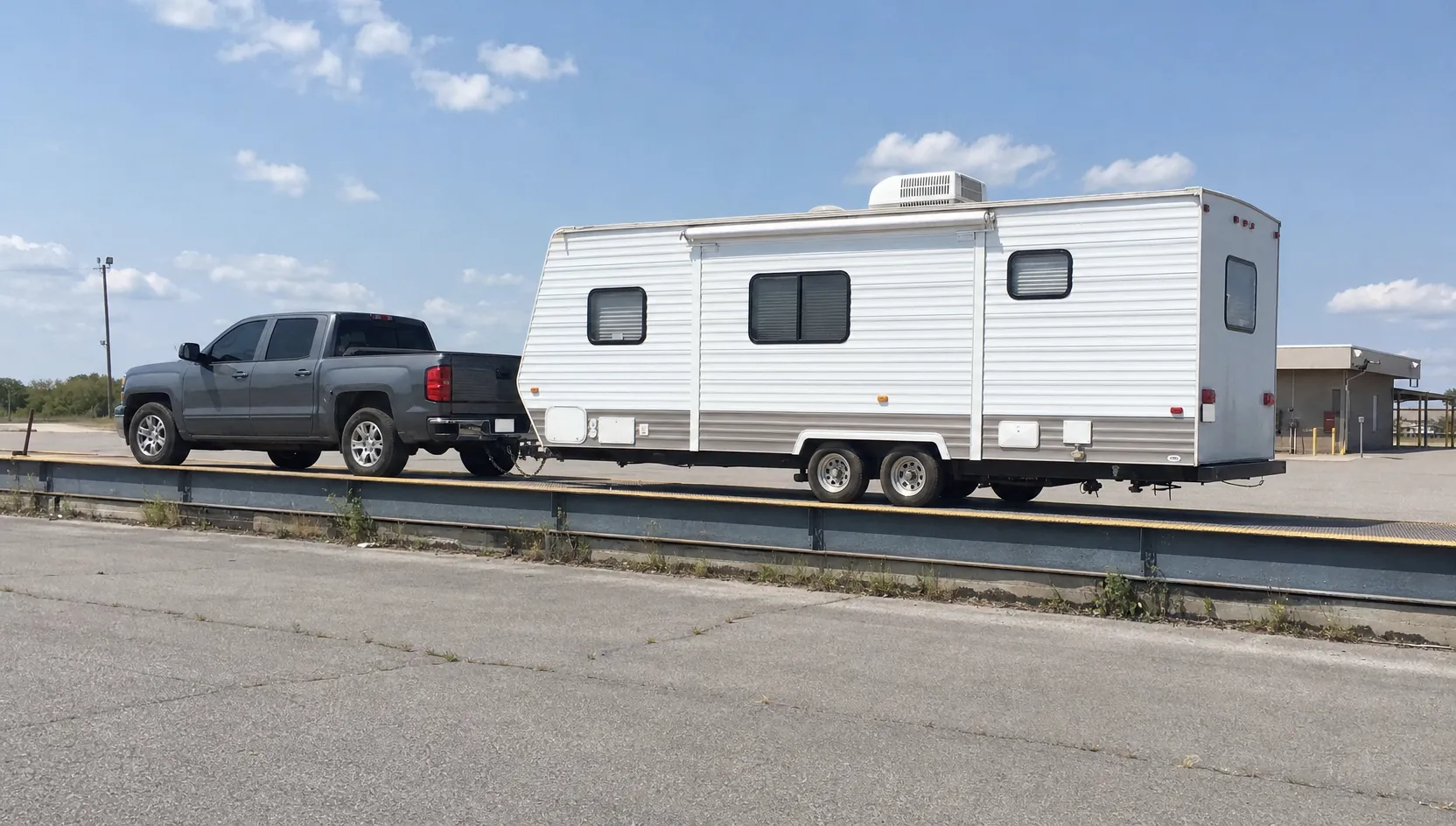
Labels give you the limits, but only a scale shows where you stand. Pack the RV the way you travel, with water, food, and gear, then drive onto a public truck scale, such as a CAT scale at a truck stop, and write down every number you get.
Weigh the whole rig first, then the trailer alone or by axle if the scale allows it. Compare the results with your GVWR, your axle ratings, and your tow vehicle’s numbers, and take weight out before you drive if any number is over.
Common GVWR Mistakes
Using dry weight. The brochure weight leaves out water, propane, and gear. Use the GVWR until you have a scale reading.
Mixing up the ratings. GVWR, GCWR, and towing capacity answer three different questions, so match each one to the right vehicle.
Forgetting the tow vehicle. Your truck has a GVWR too, and your tongue weight, passengers, and cargo all count toward it.
Ignoring axle ratings. An RV can sit under its GVWR and still overload one axle, so weigh each axle when the scale allows it.
Filling every tank. A full fresh water tank adds hundreds of pounds, so travel with only the water you need and fill up at camp.
Your Next Step
Find the GVWR label on the RV you’re considering, subtract the dry weight, and write both numbers down. Then check them against your vehicle’s ratings before you sign anything. If you’re still choosing between a trailer and a motorhome, our guide to RV types shows the differences, and our beginner’s guide covers the rest of your first trip.