

30 amp vs 50 amp RV service decides how much you can run at once before a breaker trips. A 30-amp rig tops out around 3,600 watts, while a 50-amp rig can reach 12,000 watts, and many first-timers learn the difference when the air conditioner and microwave start together. This guide shows how to read your plug, what each service can power, and what an adapter does when the pedestal doesn’t match your rig.
Read Your Plug First
Count the prongs on your power cord first. A 30-amp plug has three: one 120-volt hot wire, a neutral, and a ground. A 50-amp plug has four, with two hot wires, a neutral, and a ground, according to Camping World.
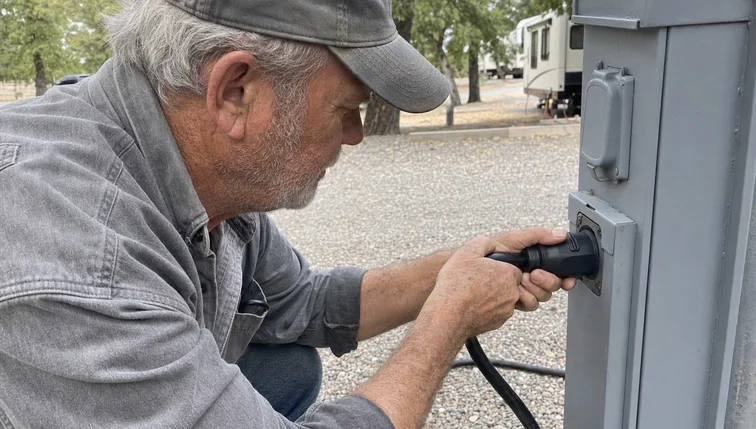
Pedestal outlets are usually the straight kind, while the plug on an RV is often a twist-lock. RV Travel says adapters exist between those two styles and between 30 and 50 amps, so a mismatch is rarely a dead end. If you lose track of your service, your owner’s manual states it, so check there before you buy an adapter.

How Many Watts You Get
Watts equal amps times volts. A 30-amp service runs one 120-volt line, so 30 × 120 gives you 3,600 watts. A 50-amp service runs two 120-volt lines at 50 amps each, which adds up to 12,000 watts on paper. Those numbers are the ceiling for each service.
That total has a catch. A 50-amp RV has a split breaker panel, and Camping World’s technician tip says the two sides share a trip bar, so overloading one side at 50 amps, or 6,000 watts, shuts off both. Your usable power ends up below 12,000 watts, and a technician can rebalance the load if one side keeps tripping.
What Runs at Once
Add up your amps before you start the appliances. Camping World lists averages of about 15 amps for an air conditioner, 10 for a microwave, 10 for a water heater element, and 5 for a refrigerator. The first three rows hit the 30-amp ceiling, and the fourth pushes you to 40 amps, which trips a 30-amp breaker but fits on 50. Labels give your exact numbers.
| Add this | Typical draw | Running total |
|---|---|---|
| Air conditioner | 15 amps | 15 amps |
| Refrigerator | 5 amps | 20 amps |
| Microwave | 10 amps | 30 amps |
| Electric water heater | 10 amps | 40 amps |
What Trips Your Breaker
Heating elements are the usual culprits. Space heaters, coffee makers, hair dryers, electric fireplaces, and electric skillets all pull a lot of power, and Camping World says they may require turning something else off. On 30 amps, RV Travel says you can’t run more than one air conditioner and a microwave together.
When a breaker trips, switch off the heaviest loads first. Reset the breaker, then bring the loads back one at a time, starting with the air conditioner. If the pedestal breaker is the one that tripped, ask campground staff before you keep resetting it.
Which One Do You Need
Your choice depends on how many air conditioners and big appliances you run. Camping World says a 30-amp RV works well for smaller rigs with one air conditioner, while larger RVs with several need 50-amp power. Airstream splits its lineup the same way: 30 amp is standard with one air conditioner, 50 amp with two.
A 50-amp system doesn’t charge your batteries any faster, because the extra power only runs the second air conditioner. Check what campgrounds on your route offer, too, since Airstream notes that not every site has 50 amp even as more campgrounds add it. Not sure which rig fits your trips? Our types of RVs guide compares the classes.

Pedestal Limits
The pedestal sets the ceiling, whatever your RV can handle. Airstream says a 50-amp pedestal lets a 50-amp trailer run both air conditioners at once, while a 30-amp pedestal runs only one, even if the trailer has two. RV Travel adds that a 50-amp RV can run two or even three air conditioners together.
Ask for the pedestal amperage when you book a site, since not every site has 50 amp. Bring the right adapter either way, and you won’t scramble at the pedestal.
Power From a Generator
On a generator, watts set the limit instead of the pedestal. Camping World’s example is a 5,500-watt generator at 120 volts, which supplies up to about 45.8 amps, so you still add loads one at a time. Our generator size calculator checks your total, and our boondocking guide covers off-grid power in more depth.

Subscribe to
Our Newsletter
By joining, you agree to receive emails.
See our Privacy Policy.
What Adapters Do
Small RV, big pedestal. An adapter makes this safe, but you still get 30 amps, or 3,600 watts, according to Airstream’s support page. A 50-amp adapter doesn’t add power to a 30-amp RV.
Big RV, small pedestal. Camping World says an adapter limits you to 3,600 watts. Sources split on what runs: one storage-company guide says air conditioners won’t, while Airstream says one will. Plan on one air conditioner at most.
A household outlet. Camping World puts a 30-amp RV at 2,400 watts on a 20-amp outlet and 1,800 watts on a 15-amp outlet. Airstream says a 15-amp outlet keeps your batteries charged but can’t run the trailer at full power.
A dryer outlet. RV Travel warns that most 30- and 50-amp outlets that aren’t RV plugs, such as home dryer outlets, supply 240 volts, which can wreck an RV’s electrical system. Use an outlet installed for RVs.
Before You Plug In
Run through this short list every time you arrive. It takes two minutes and prevents most tripped breakers, and our campsite setup guide covers the rest of the arrival routine.
- Switch the pedestal breaker off, plug in, then switch it back on.
- Use a surge protector rated for your service, 30 or 50 amp.
- Carry a 50-to-30 amp adapter if your RV is a 50-amp model.
- Turn off the big loads, then add them back one at a time.
- Add up the amp draws from your labels instead of guessing.
- Confirm the outlet is made for RVs, never a dryer outlet.
Your Next Step
Count the prongs on your cord tonight and write the number on a card in your glovebox. Our RV checklist covers the other things to confirm before you leave, so you roll out with your power sorted and no surprises at the pedestal.