
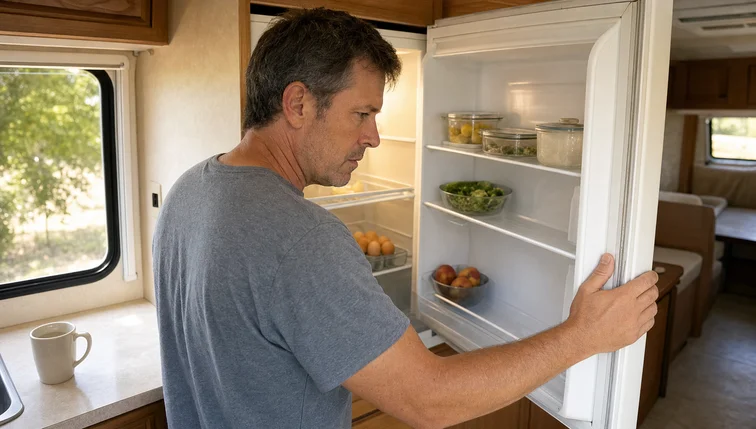
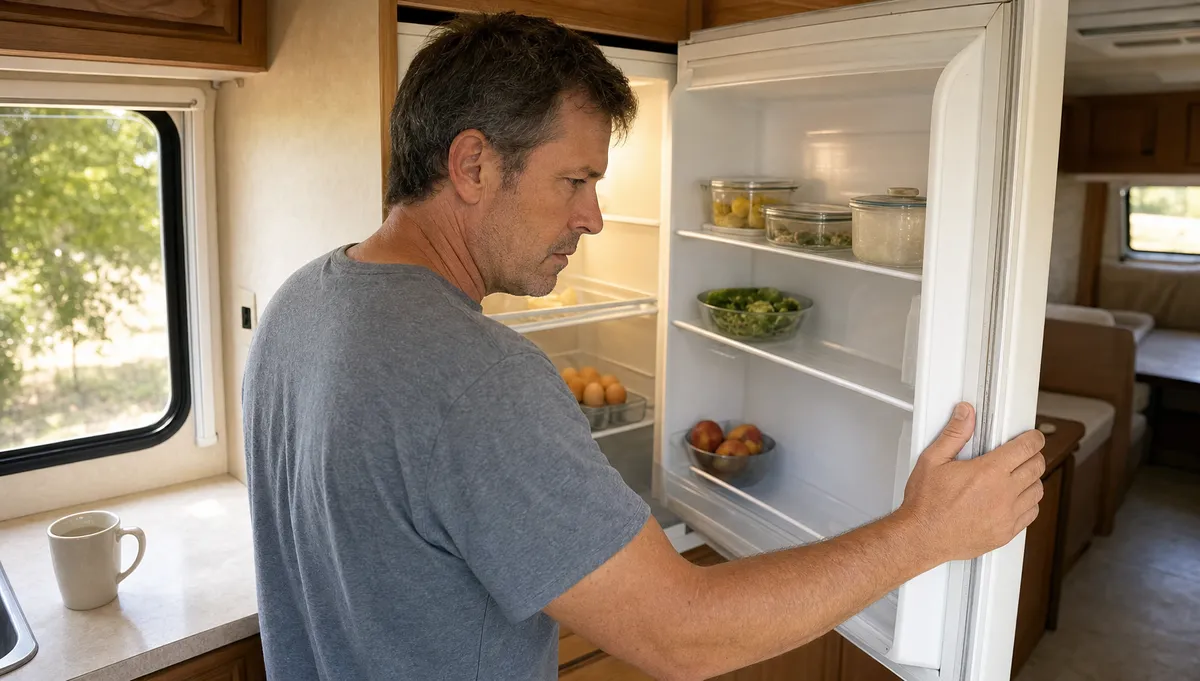
RV refrigerator not cooling is usually fixable, and the cause tends to be one of five things: the RV isn’t level, a power source has failed, air can’t flow behind the fridge, a thermostat clip has slipped, or the fridge hasn’t had enough time. This guide runs the checks in the order a technician would, shows how level your fridge has to be, and flags the signs that mean you should stop and call a pro.
Know Your Fridge Type
Your fridge runs one of three ways, and the type decides what to check. A 12-volt fridge runs on battery power. A 2-way fridge uses 120-volt power first, then propane, and switches back when power returns. A 3-way uses 12 volts first, then propane, then 120 volts, and Camping World warns that it can drain your batteries.
This guide focuses on gas-electric absorption fridges, the kind with a flame and no compressor. The cooling fluid inside has to flow downhill, which is why level matters so much. A 12-volt fridge shares the airflow, thermostat, and door-seal checks below.
Give It Time to Cool
Check how long the fridge has been running before you assume it’s broken. Camping World says a 12-volt model needs 2 to 3 hours and a gas-electric one needs 6 to 12, and Roadtrippers says up to about 8. Set a thermometer on the middle shelf, and if it still reads above 40°F after 12 hours, start the checks below.
Check Level First
Check level before anything else, because it costs nothing and rules out the one problem that can wreck the cooling unit for good. An absorption fridge has no pump, so gravity moves the fluid. On a slant it can pool and form crystals that block the tubing, and that damage builds over time, according to RV Travel.
Norcold says its gas absorption fridges can’t go past 3 degrees off level one way or 6 degrees the other, and a couple of models swap those numbers. Dometic words it differently by manual: one asks for no noticeable slope, another lists the same 3 and 6 degrees. Aim for 3 degrees both ways.
Check Level at the Fridge
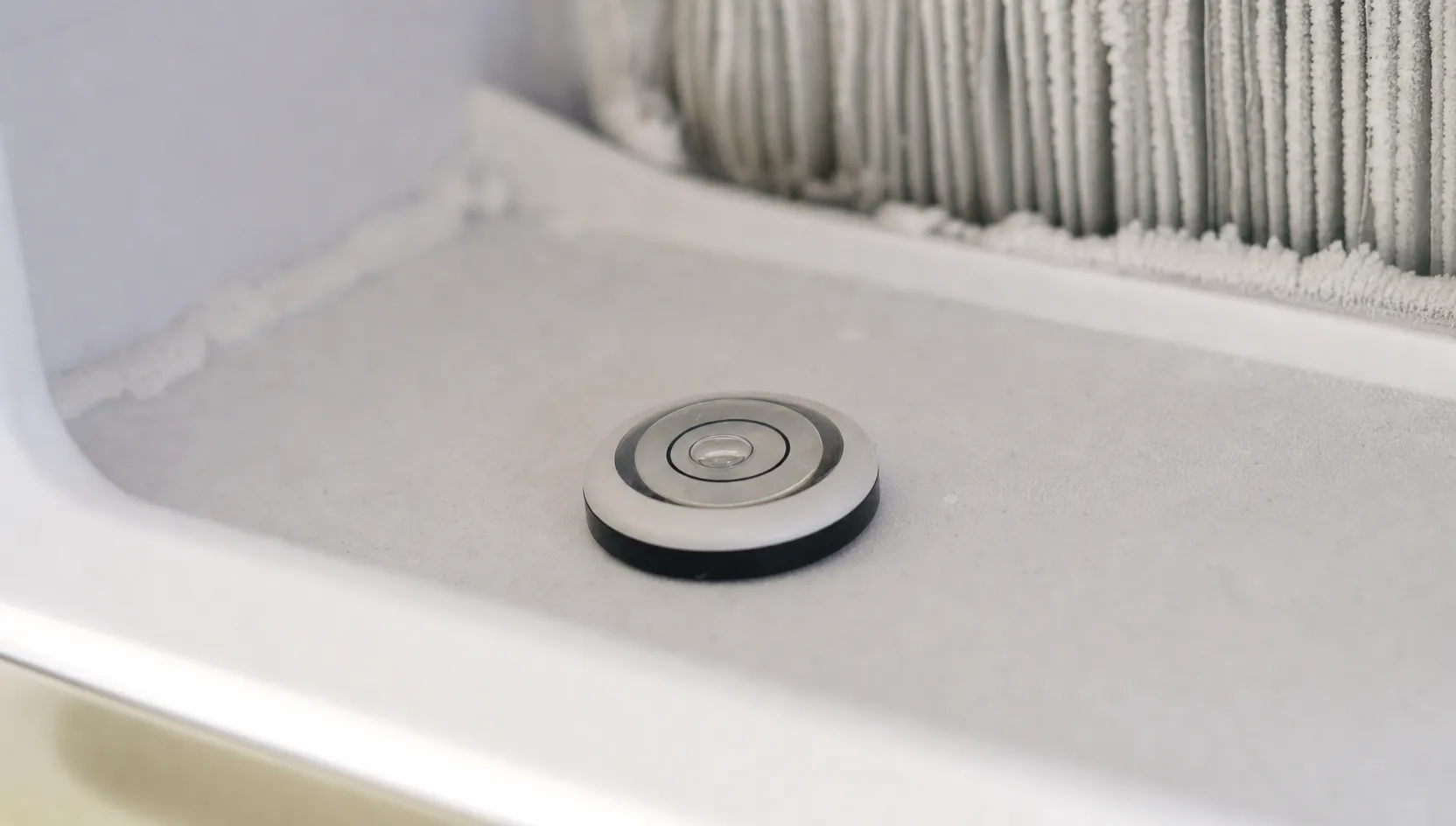
Set a small round bubble level on the freezer floor and read it after the RV stops moving. Dometic’s installation guidance says the fridge should be level both ways in the freezer compartment, so measure there instead of trusting a bubble on your counter. Adjust with blocks under the tires, as our campsite setup guide shows.
What 3 Degrees Looks Like
Degrees are hard to picture, so here is the math: rise equals distance times the tangent of the angle. That works out to about 5/8 inch per foot at 3 degrees and 1 1/4 inches per foot at 6 degrees. Across an 8-foot-wide RV, 3 degrees is about 5 inches. These figures are my own arithmetic, not a manufacturer chart.
| Distance | Rise at 3° | Rise at 6° |
|---|---|---|
| 1 foot | 0.6 in | 1.3 in |
| 2 feet | 1.3 in | 2.5 in |
| 8 feet (RV width) | 5.0 in | 10.1 in |
| 20 feet (RV length) | 12.6 in | 25.2 in |
Quick Stops and Overnight
Sources split on short stops. Dometic’s manual says to level whenever the RV sits for several hours with the fridge running, and it says level matters less while driving, because the motion keeps fluid from pooling. RV Travel’s Dave Helgeson argues that the damage is cumulative, so he says to level at every stop.
If you can’t level, he says to shut the fridge off for any stop of about 30 minutes or more. That’s a cheap habit, since USDA power-outage guidance says a closed refrigerator keeps food safely cold for about 4 hours if you leave the door shut.
When It Won’t Turn On
A dead control panel often points to a power problem instead of a broken fridge. Check the battery charge, since Camping World says anything below 10.5 volts is too low, then the battery disconnect switch, breakers, and fuses. Look for the interior light, and give the fridge 2 to 3 hours with a thermometer inside before you decide it isn’t cooling.
Electric Works, Propane Doesn’t
Start with the propane supply: check the tank level, open the valve fully, and confirm the regulator works. If an indoor propane appliance was running before you opened the valve, the excess flow valve may be limiting the gas. Roadtrippers says to shut off indoor appliances and the valve, wait a few minutes, then reopen it slowly.
After three failed ignition attempts the fridge locks out, so turn it off, run a stove burner to push air out of the lines, and restart it, as Camping World describes. The burner needs 12-volt power to spark, so a weak battery can stop it too, even when the tank is full. Our boondocking guide covers battery power.
Look at the Flame
Many fridges have a small sight hole at the burner. RV industry veteran Dave Solberg says the flame should be steady and blue and touch the thermocouple, while a bouncing, orange, or low flame points to low gas pressure or a blockage. He adds that a fully charged flooded battery reads about 12.6 volts, and weaker readings can mean a weak flame.
Propane Works, Electric Doesn’t
Check the RV’s breaker, any surge protector, and the pedestal first, since Camping World says to confirm the 120-volt supply. Then make sure the fridge’s power cord is fully seated in the outlet inside the lower access panel, as Roadtrippers notes. If both check out, the heating element or a board fuse is the likely culprit, and both are technician jobs.
Airflow Behind the Fridge
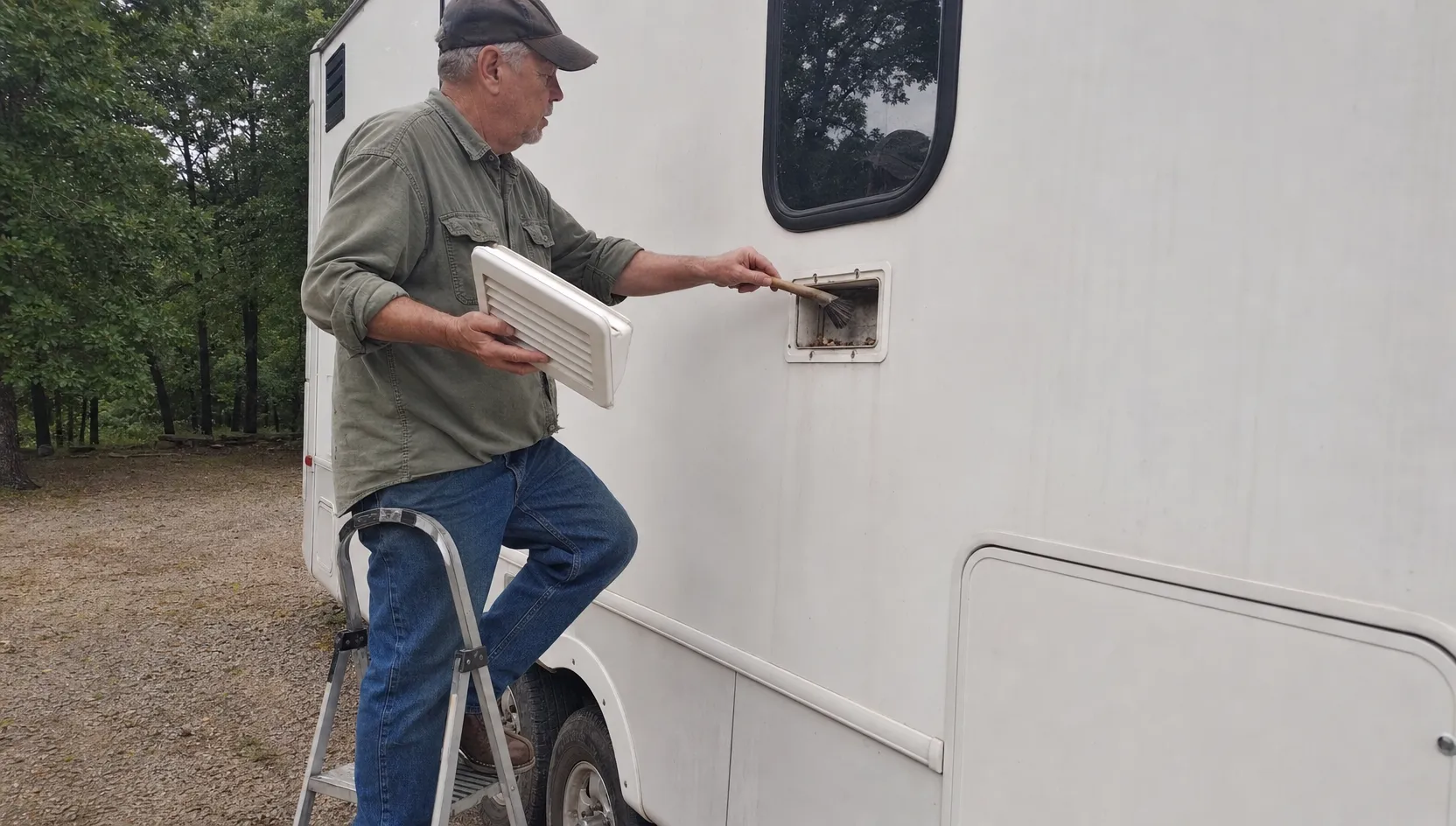
An absorption fridge sheds heat through the outside vents, so blocked air means a warm fridge. Camping World describes air moving from the lower access panel up the back and over the coils. Dometic says to keep the lower and upper vents and the space between them clear of nests, webs, and debris, and to check them yearly.
Turn the fridge off first, then remove the vent covers, vacuum out debris, and clear the coils, as RVshare describes. Check that the small drip tube cap is in place too, since Roadtrippers says an open tube lets warm air in. Adding an airflow baffle is a technician job.
Thermostat Clip
The thermistor is a small plastic clip on a cooling fin at the back of the fridge, and Camping World says the Colder to Warmer setting can get bumped while you load groceries. RVshare says the clip can slip during travel and that moving it higher on the fins can make the fridge colder. A replacement runs about $10 to $30.
Test the Door Seal
Close the door on a dollar bill and pull it out. You should feel moderate resistance all the way around, according to Camping World, and a loose spot points to a gap in the seal. RVshare says you can replace a seal yourself for about $15 to $40 in 15 to 30 minutes.
Subscribe to
Our Newsletter
By joining, you agree to receive emails.
See our Privacy Policy.
Pack the Fridge Smart
Overpacking blocks air, and Roadtrippers notes that absorption fridges have no internal fan to push it around. Let hot food and drinks cool before they go in, as Dometic’s manual says, and J.D. Power suggests keeping the coldest items toward the back. Roadtrippers says an aftermarket fan can help circulation if the fridge still runs warm.
Heat and Altitude
Absorption fridges can struggle in extreme heat, so park in shade when you can, as RVshare suggests. Dometic adds that above 5,500 feet, propane operation loses efficiency and the burner may go out, so run the fridge on electric power at elevation.
Keep Your Food Safe
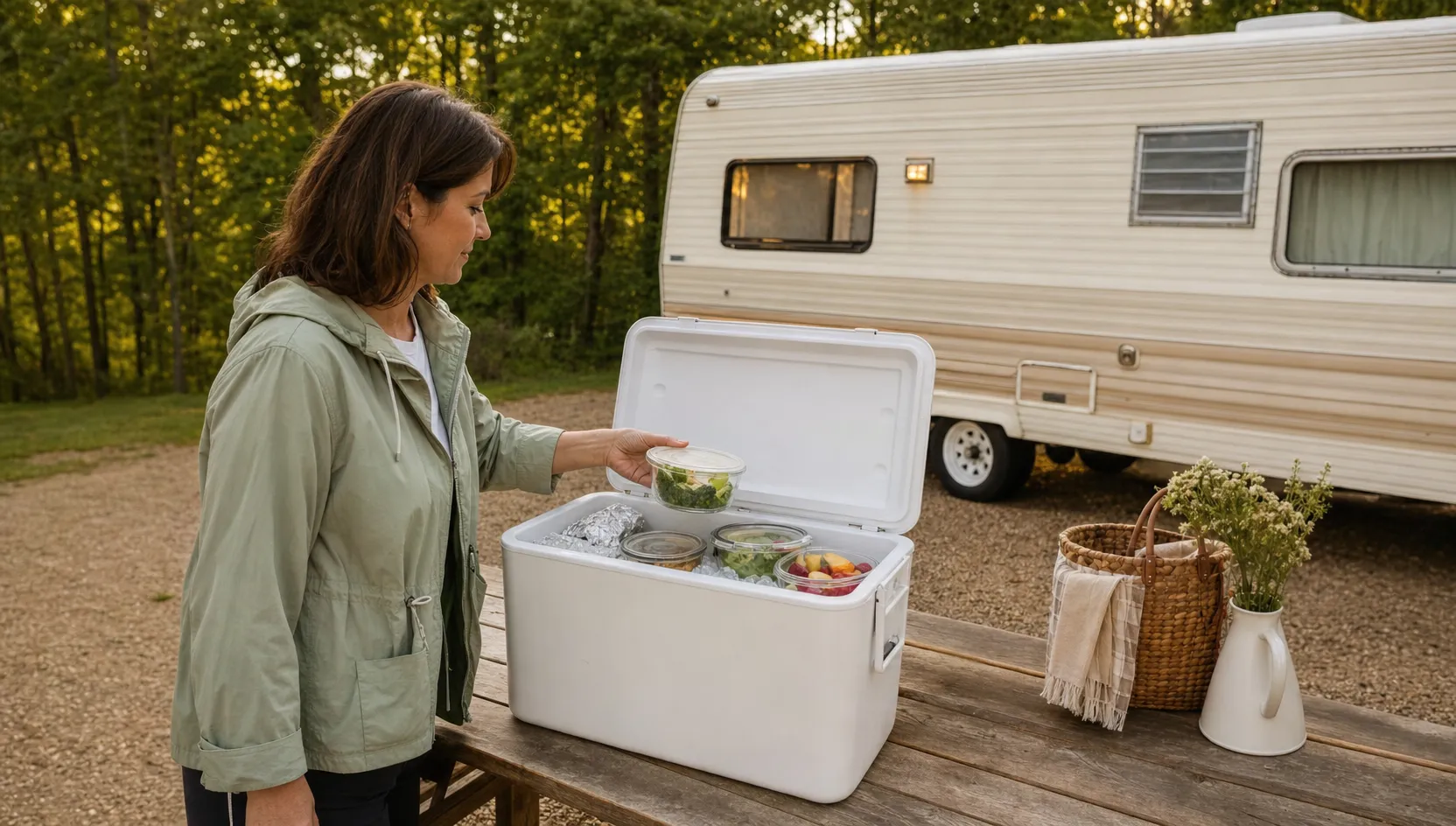
Keep the door shut and a thermometer inside while you work. The USDA says perishable food held above 40°F for more than 2 hours should not be eaten. Smell won’t warn you, since harmful bacteria usually don’t change how food looks or smells. Move perishables to a cooler with ice until the fridge holds 40°F again.
Pre-Trip Fridge Checklist
Run through this list the day before each trip. It takes ten minutes and catches most problems while you’re still at home, with help nearby. Each item matches a check above, so skip the ones you’ve done, and our RV checklist covers everything else.
- Level the RV on the driveway before you pre-cool the fridge.
- Switch the fridge on the day before, on electric power.
- Set a thermometer on the middle shelf and read it before loading food.
- Clear the vents and lower access panel of nests and webs.
- Test the door seal with a dollar bill.
- Run the fridge on propane once so air clears from the lines.
When To Call a Pro
Ammonia smell. Turn the fridge off, leave the door shut, ventilate, and step outside, then close the propane valve and shut off 120-volt power, as Dometic’s manual says. Don’t use the fridge again until it’s repaired.
Yellow-green powder. That residue is a rust inhibitor leaking out with the ammonia, and the cooling unit is the likely source. RVshare puts a replacement unit at $800 to $1,500 or more, sometimes close to the price of a new fridge.
Repeated lockouts. If ignition keeps failing after you’ve purged the lines and checked the propane, the burner may be dirty or the electrode corroded. Both need a technician.
Dead heating element. If propane works and 120-volt power doesn’t after you’ve checked the breaker and the plug, suspect the element or a board fuse. RVshare notes that a failed element often makes a new fridge the cheaper route.
Gas pressure problems. A bouncing or orange flame can mean low pressure. A proper pressure check takes a gauge, and Solberg leaves that to a technician.
Warm after 24 hours. Once level, vents, thermostat, and seal check out, let the empty fridge run for 24 hours, as J.D. Power suggests. If it still won’t cool, a technician should look at the cooling unit.
Your Next Step
Put a small bubble level on your freezer floor the next time you park, and note how far the bubble sits from center. Then book the yearly fridge inspection for the off-season, as Camping World recommends, and use our winterizing guide to handle the rest of storage prep.