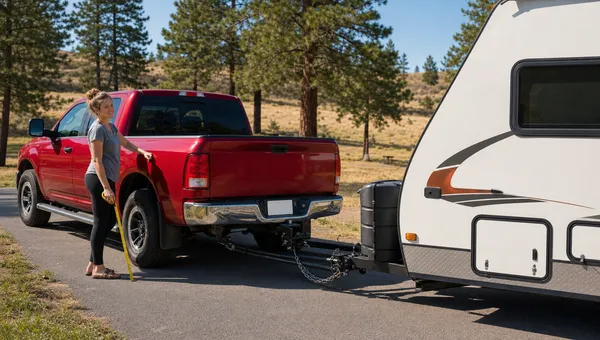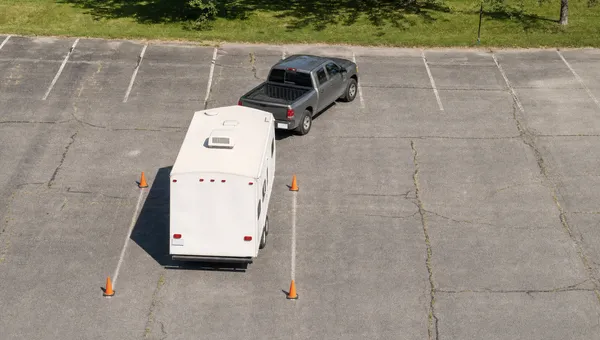



Tongue weight is the downward force a loaded trailer puts on your hitch ball, and it should be 10 to 15 percent of the trailer’s loaded weight. Too little and the trailer can sway. Too much and your truck squats and steers poorly. This guide shows how to measure it at home and what to change when the number is off.
Why Tongue Weight Matters
A trailer wants to pivot around its axles. When part of the load sits ahead of them, that weight presses down on your hitch and keeps the trailer pulling straight behind you. Move the load toward the back and the tongue starts to lift, which sets up a swinging motion that The Autopian compares to a pendulum.
Too little tongue weight is the more common problem. etrailer’s experts say it is more often to blame for sway, while too much usually shows up as a sagging rear end on your tow vehicle. Neither is a comfortable way to drive down the highway, so a number you measured yourself beats a guess from a spec sheet or a forum post.
Ideal Tongue Weight Range
You will also see tongue weight called hitch weight, tongue load, or nose weight. Fifth wheels call it pin weight. Ford’s F-150 towing guide sets 10 percent of the loaded trailer weight as the target, and many owner’s manuals give a range of 10 to 15 percent.
Fifth wheels sit over the truck bed and run higher, at about 15 to 25 percent. The table shows what the travel trailer range works out to for four common weights.
Your truck’s owner’s manual lists its maximum tongue weight, and your receiver label lists its own, so the lower number is your ceiling. Compare your result with the Tongue Weight Calculator and the ratings in our hitch guide.
| Loaded trailer weight | Tongue weight at 10% | Tongue weight at 15% |
|---|---|---|
| 4,000 lb | 400 lb | 600 lb |
| 6,000 lb | 600 lb | 900 lb |
| 8,000 lb | 800 lb | 1,200 lb |
| 10,000 lb | 1,000 lb | 1,500 lb |
Loaded Beats Dry
The tongue weight printed on a spec sheet is usually a dry number, taken from an empty trailer. etrailer says the same, so check yours again after you load up. Propane tanks and batteries ride on the A-frame, which puts them right on your hitch ball, and every bin of gear you pack changes the number too.
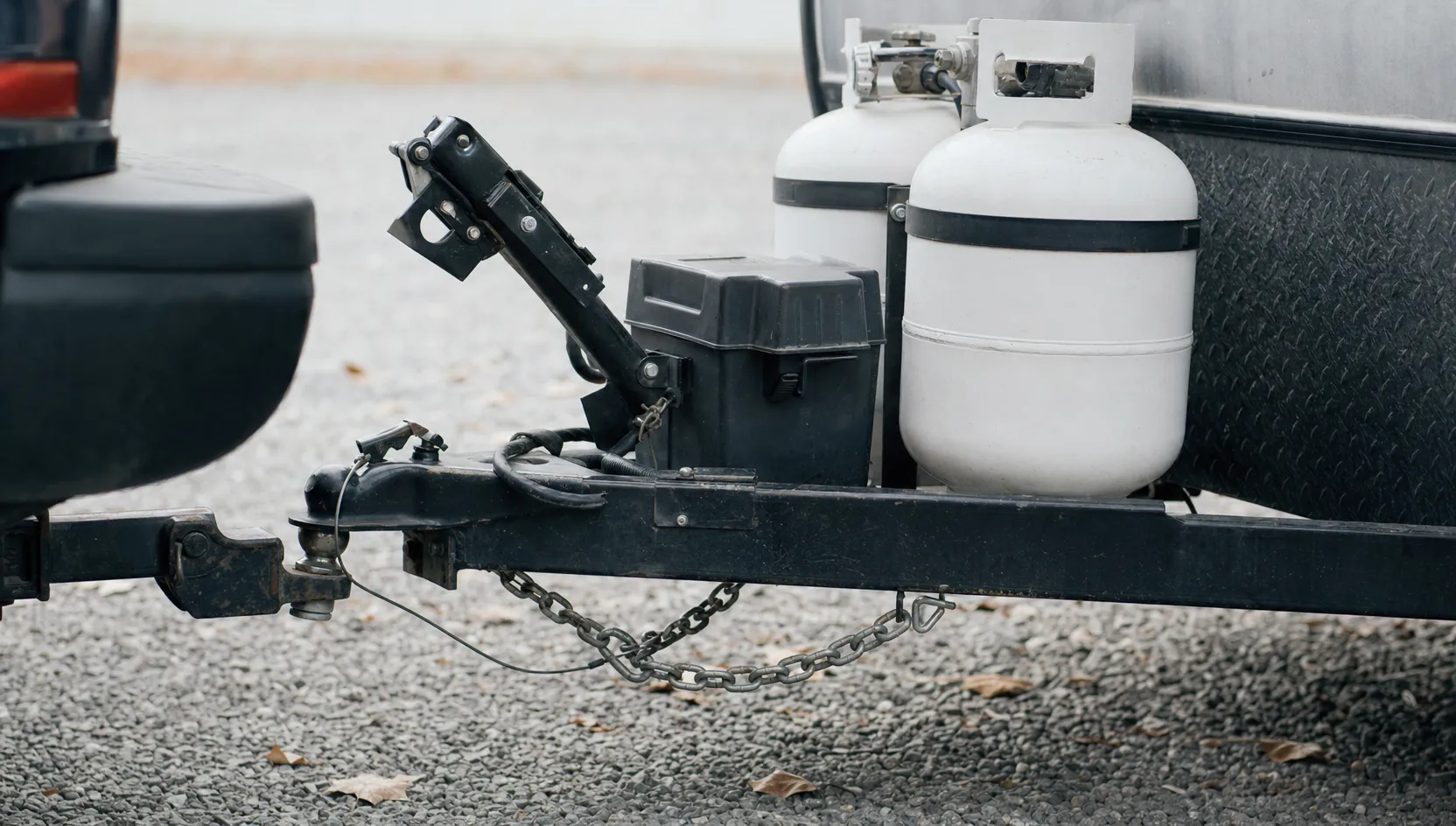
Use the loaded weight for every calculation in this guide. Our GVWR guide explains the weight terms on your trailer’s label, so you can tell a dry number from a loaded one.
It Counts Against Payload
Tongue weight rides on your tow vehicle, so it eats into your payload. Ford’s guide spells it out, and Ram says payload plus tongue weight cannot exceed payload capacity. Passengers and cargo in the truck count too.
Say your door sticker lists 1,600 pounds of payload. A 750-pound tongue weight, two adults, and 300 pounds of gear in the truck come to about 1,400 pounds, which leaves only 200 to spare. The Payload Calculator runs that math with your own numbers.
Before You Weigh
A reading only helps if the setup matches how you tow. Go through this list first, because shortcuts can throw off the result.
- Load the trailer the way you will tow it, with water, propane, batteries, and gear.
- Park on level ground and level the trailer from front to back.
- Take the spring bars off if you use a weight distribution hitch.
- Pack the tow vehicle as usual if you plan to use a truck scale.
- Note the loaded trailer weight, since you need it for the percentage.
Three Ways to Measure
Each method fits a different budget and trailer size. A dedicated scale is the easiest, a bathroom scale works for light trailers, and a truck scale handles anything. All three need a loaded, level trailer, as etrailer describes.
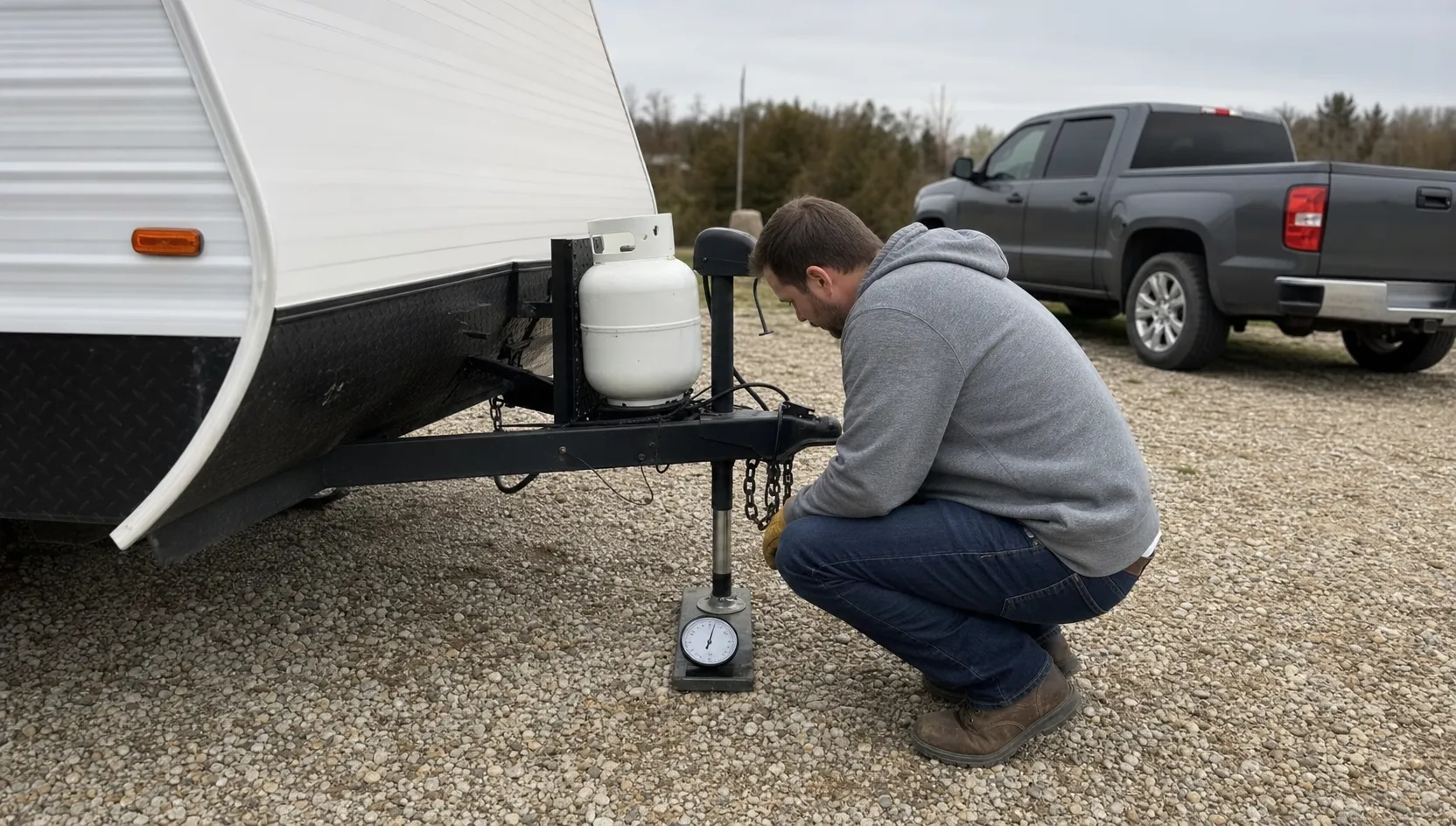
Tongue Weight Scale
A tongue weight scale sits under the tongue jack. Set the loaded trailer on it at towing height, lower the jack until the scale carries the load, and read the dial. Some ball mounts have a scale built in, which saves the setup.
These scales do not work with spring bars attached, so remove the bars first. If you want to know how much weight the bars move, take one reading without them and a second with them on. The difference shows what the hitch does for your setup.
Bathroom Scale
A bathroom scale suits a light trailer whose tongue weight fits within its limit. Set it under the jack, add a wooden block if the jack sits too high, and lower the jack onto it. Use an analog scale that reads zero before you start.
For a heavier tongue, build a lever. Put the scale on one side and a brick of the same height on the other, with a board across two pipes. Set the jack one foot from the brick pipe and two feet from the scale pipe, then multiply the reading by three. Stick to light trailers, because a board and a bathroom scale can fail under a heavy tongue.
Truck Scale
Pull onto a truck scale with the truck hitched to the trailer, all four truck wheels on the platform, and the trailer tires off it. Record that weight. Then unhitch, raise the tongue so no weight rests on the ball, keep the jack off the scale, and weigh the truck alone.
Subtract the second number from the first, and the difference is your tongue weight. A 5,300-pound reading hitched and 4,600 pounds alone gives 700 pounds. Fuel the truck and load it as you will for the trip, or the numbers will not match the way you tow.

Subscribe to
Our Newsletter
By joining, you agree to receive emails.
See our Privacy Policy.
Do the Math
Divide the tongue weight by the loaded trailer weight. A 700-pound reading on a 6,000-pound trailer is about 12 percent, which sits in the range. The same trailer at 400 pounds is under 7 percent and too light, and at 1,000 pounds it is almost 17 percent.
If your number lands outside 10 to 15 percent, change one thing and weigh again. If it lands inside the range but above your truck’s tongue weight or payload limit, the limit wins.
Signs It’s Off
Sway at highway speed. A trailer that swings after a gust or a passing truck often has too little weight on the hitch. Ease off the gas, pull over when it is safe, and check where the heavy items sit.
Light, vague steering. A heavy tongue lifts the front of your tow vehicle and takes weight off the steering tires. If the wheel feels loose on the highway, the tongue is probably too heavy.
A sagging rear end. The rear bumper sits well below its unhitched height, and the headlights point up at the sky. A squat like that points to a heavy tongue, and it can cause sway at speed too.
Odd braking. A tongue that is too heavy loads the rear brakes and lightens the front ones. A tongue that is too light lets the trailer push on the truck as you slow down.
How to Fix It
Moving cargo is the simplest fix, and it is usually trial and error. Change one thing, weigh again, and repeat until the percentage lands in the range.
Add Tongue Weight
Move heavy items forward, ahead of the trailer axles, into a front storage compartment or over the axles if you have no pass-through. Keep gear off the rear bumper, because spare tires, bike racks, and generators behind the axle pull the tongue up.
Remove Tongue Weight
Shift heavy gear back toward the axles, not behind them, because weight far behind the axles can bring the sway back. You can also lighten the front with smaller propane tanks or lighter lithium batteries on the A-frame.
If you cannot get under your truck’s limit, the trailer is too heavy for that setup. A weight distribution hitch spreads the load across the axles but does not shrink it, so read how it works before you buy one for this.
Your Next Step
Weigh your loaded tongue before the next trip, then divide it by your trailer weight. If it falls between 10 and 15 percent and fits your truck’s payload, you are set. If not, move one heavy item, weigh again, and write the final number on a card for your glove box.